


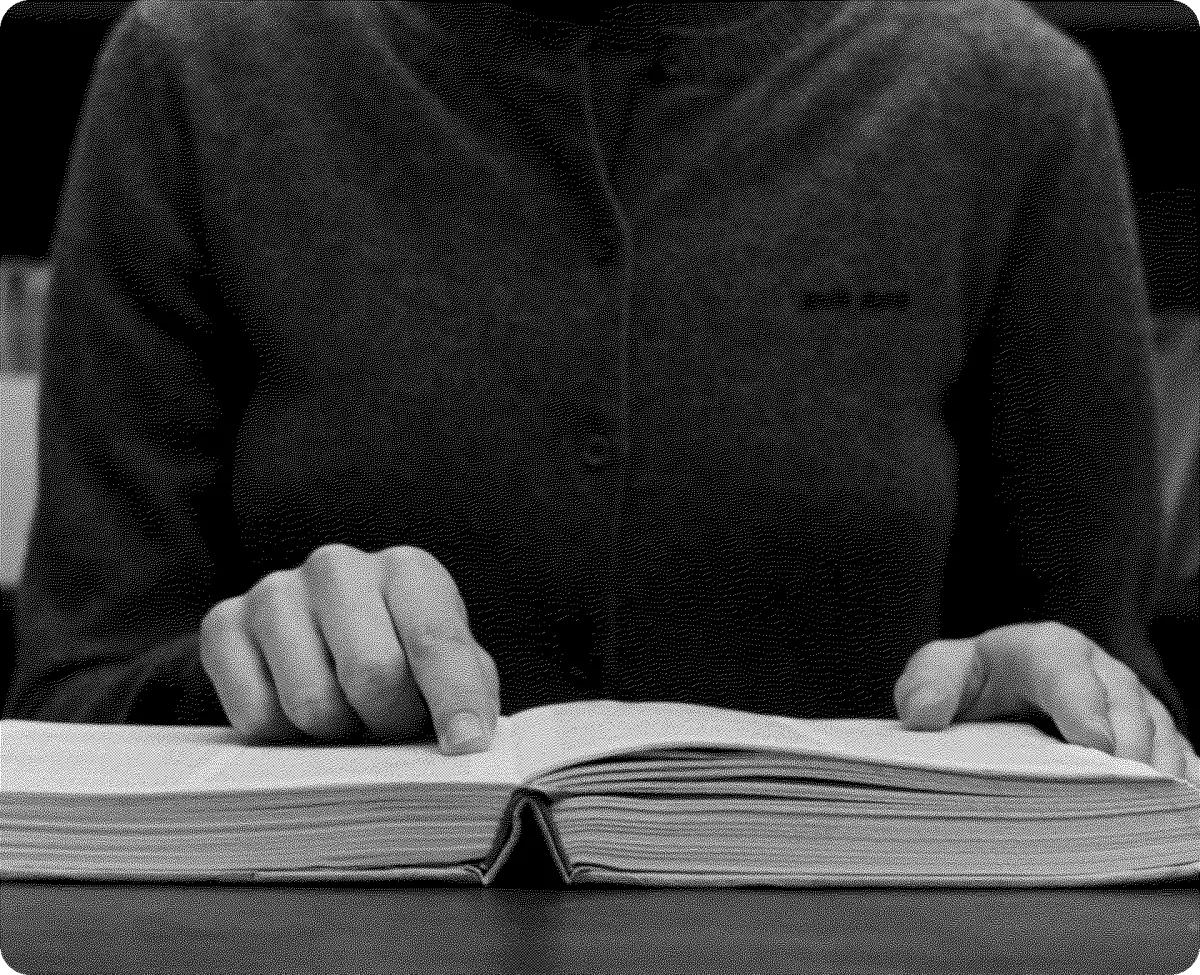
The trouble with heat coming off the road and sidewalk was that it would warm up the sample case, so that by midday Volume One had an odd aroma.
Artie set the case down before the doorstep of 114 Larkspur Drive and corrected his cuffs and shifted his weight back, over his back foot, so that the woman opening the door would not feel crowded. No lady likes a man who leans in. You lean back, you smile as if you mean it, and maybe they’ll spare you forty-five seconds.
The door opened all the way, without pause for a peek, which told him something about the household right there.
She was thirty or thirty-two, in a yellow housecoat with the sleeves pushed partway up, and she had a glass in her hand with the cubes still whole, so it’d been made in the last ten minutes. It was two-forty in the afternoon. Her hair was pinned up off her neck and one strand had come loose.
You’re the third one this month.
She nodded past him at the street.
The first was storm windows and the second was a little man who wanted to test the water for minerals. He had a kit.
Artie met the moment.
I’d never test your water, ma’am. Wouldn’t dream of it.
What would you do?
I’d offer you everything known to man on an installment plan.
She looked down at the sample case. It was burnished oxblood with P. F. COLLIER & SON in a dark gold embossing.
Books. Selling books.
Well, not exactly. Strictly speaking, I’m placing a fine encyclopedia.
Placing.
Collier’s looks for placement in prominent homes. The kind where kids will come over, where their parents will come over for bridge and a few drinks. The encyclopedia in view is the advertising. We don’t buy billboards, you see. We buy neighbors.
He said this with a smile and shrug, as if amused by his own malarkey. That was the trick. You buy into your own pitch, you never sell a damn thing. For a pitch to take root the mark needs to see it for what it is and smile, to admire the polish of the delivery, to feel that they’re invited to join in the joke. Suddenly you’re sharing a secret.
She took a slow sip of her drink.
And what does the home have to do? In this arrangement.
Nothing but own it and show it. Now, there’s a participation fee for our research service, which is separate from the printed volumes and costs less than a pack of cigarettes a day. The volumes themselves are the company’s advertising expense.
A pack a day is fourteen dollars a month.
Artie blinked. Nobody ever did the math in their head, on the porch. They did it days later at the kitchen table, after the truck had already arrived.
You’re quick.
No, I’m bored. It comes out looking quick.
She stepped back from the open door and made a gesture with the glass.
Inside, in the shade, it was easily ten degrees cooler. Blond wood in the living room, a muted green sofa, a hi-fi console and a coffee table with magazines open. On the wall over the sofa hung a print of a schooner at speed. Everything looked nearly new.
Helen Pierce.
Arthur Lund. Artie.
There’s no children, Mr. Lund, since you brought that up. Have a seat.
She dropped to one end of the sofa and nodded to the opposite end.
Go ahead, do the whole thing. I want the whole production.
So he did the entire production.
He laid the case flat on the coffee table and opened it and brought out Volume One, A to ANNO in buckram, gold-stamped, and set it in her hands so she’d have to hold the weight of it, because the weight was part of the sale. He fanned the color plates ⋯ the cutaway of the human heart, the flags of the world, the seven-page foldout of the solar system. He showed her the Research Service card, good for twelve inquiries a year on any subject and answered promptly by their full-time staff in New York. He told her about the woman in Sewickley who wrote in asking how to tell a hawk from a falcon and got back four single-spaced pages and a bibliography.
Did she really?
Well, according to our boss. He also tells us to tell you about a fellow in Ohio who used the set to pass his pharmacy boards. Truth be told, I’ve never met that character either.
Helen laughed. It came out suddenly and sideways, like she’d stepped on a loose stair board.
You’re not very good at this.
I’m the best in the region.
Then god help the others.
He showed her a picture of the bookcase, which came in a walnut finish, forty-two inches, free right down to delivery. He showed her the terms of the yearbook subscription, which renewed annually, automatically, so that the set stayed current. After all, the world was going to keep happening and this thing in her house would need to keep up with it. He showed her the index of the newly expanded 1962 edition, twenty-four volumes where before there’d been twenty, partly driven by added African nations.
Helen raised an eyebrow.
Oh yes ⋯ twenty-some new countries since fifty-seven. Whole continent’s changing most of its names. The twenty-volume set had a Belgian Congo section and that’s not even a place anymore.
She looked at Volume One in her lap for a while.
So what happens to those twenty-volume sets?
Ma’am?
The ones out in people’s houses. With the Belgian Congo in them.
Artie hadn’t given that thought. There was no training on the topic.
I guess they just sit there being wrong. But mighty handsomely.
Mrs. Pierce put her hand flat on Volume One.
All right.
He pulled the contract out of the case, along with the pen and the receipt book. She signed as Helen M. Pierce in a small tight hand that slanted backward.
There’s a down payment. Thirty dollars, which comes directly off the total. Check is fine, but paying in cash gets a nice discount, takes it to twenty-five.
She went back to the kitchen and returned in seconds, counting out bills on top of the coffee table ⋯ a ten and three fives. He slid it into a deposit envelope and wrote a receipt with carbon beneath, then detached the top sheet and passed it to her.
Hang on to that. That’s your proof of everything.
There were two slots still empty on the contract form.
Husband’s name?
Don. Donald Pierce
Employer?
He’s with Keystone Machine Parts, out of McKeesport. He’s on the road quite a bit.
I see.
Three weeks out of four. When things are really jumping it’s three-and-half.
Artie filled in the blanks and made a sympathetic sound.
That must be difficult at times.
I manage. Lot’s of reading, you know?
And now there’ll be even more.
They both stood.
There’s a follow-up ten days from delivery. That’s standard.
Helen walked him to the door.
Ten days. I’ll mark the calendar.
BRAIN-WASHING is a technique by which the mind and opinions of an individual are forcibly altered against his will. The procedure combines prolonged isolation with intermittent and sustained interrogation, the deprivation of sleep and food, the alternate administration of severe threat and calculated kindness, and the relentless repetition of slogans and confessions.
The phenomenon has been the subject of increasing attention by psychologists and military physicians, who regard the construction of a defense against it as indispensable to free governments confronted by totalitarian methods. Imperfect resistance may be achieved by mental conditioning, group discipline, and prior training.
Larkspur Drive ran uphill until it turned left to become Larkspur Court. The whole development was like that ⋯ variations of floral names in a nosegay of nonsense. Rosedale Manor. There was no manor, no dale, and not even a rose. Two years back it had been the languishing Kercher farm and before that a density of weed and wood.
Artie had worked the odd side of the drive to the top of the hill and then the even side back down. Aside from the yes from Mrs. Pierce, there was a maybe from a woman with a toddler on her hip who said her husband would want to look at the payments. That counted as no.
When he made it back to the car he tossed the case and his jacket on the back seat and rolled the windows down to release some heat. There was a decision to make ⋯ whether to log the deposit or pocket the cash. He didn’t view the holding as theft. He was borrowing against sales that hadn’t been booked but eventually would ⋯ the company would get its money and the customer the books. A subscription entered the system as soon as his own, more pressing obligation was met.
He looked back up the hill at the Pierce house, white with green shutters, same as three others on Larkspur if you included both Drive and Court. The woman’s deposit would put him over the line for the month, but then he wouldn’t see her for an uncertain number of weeks.
He sat down, starting to sweat, and watched the heat ripple the air above the hood.
Helen’s set arrived on time, on a Tuesday, by way of a panel truck and a man in coveralls who declined her offer of water.
The man put the bookcase against the wall under the schooner ⋯ shifting the sofa ⋯ and loaded the volumes left to right in letter-locked order. Then he ran his sleeve down the spines to line them flush in one pass and stepped back to confirm his work. He had Mrs. Pierce sign a slip confirming delivery, picked up his boxes, thanked her, and left.
She stood in the living room with the yellow slip in her hand. Twenty-four books. She counted them by twos with her index-and-forefinger, then squatted on the floor in front of them, back braced against a leg of the coffee table. She started from A to ANNO.
She’d been reading four hours a day for two years, so long as they’d been in Rosedale, and didn’t feel she had much to show for it. It’d been library books and magazines and paperbacks from the Rexall rack and it all passed through her head like water through cheesecloth. This felt different. This had an order to it. This started at Aachen and went all the way to Zwingli and between those two anchors it enumerated everything.
She read the entry on Abelard. She read the entry on Absinthe. She read the one on Achilles Tendon, which had a cutaway diagram, and Acoustics, and Adobe, and by the time she stood up the light in the room had softened to amber and it was six-fifteen and she hadn’t started dinner. Which was all right because there was no coming to join her.
DDT (dichloro-diphenyl-trichloroethane) is a chlorinated hydrocarbon insecticide first synthesized by the German chemist Othmar Zeidler and brought to practical use against insects in 1939. During the Second World War DDT was dusted on more than a million Allied soldiers and civilians to suppress outbreaks of typhus; since 1945 it has been applied in massive quantities to crops, swamps, and dwellings throughout the world, and is the principal weapon by which the World Health Organization has driven malaria from vast areas of the tropics where the disease had been endemic for centuries.
Among its many virtues DDT is cheap, persistent, and singularly harmless to man and to the higher animals, exhibiting low acute toxicity to mammals. Its chemical stability allows a single treatment to remain active for weeks, reducing the need for repeat applications. Most entomologists consider DDT to be among the two or three discoveries that have most relieved mankind of insect-borne suffering.
Don called collect on Thursday from Youngstown, at nine, as usual.
How are you ⋯ how’s the house?
The house is fine.
Anyone call?
Your mother. She wants to know if we’re coming for Labor Day.
What’d you tell her?
I told her I’d ask you.
Well, ask me two days before Labor Day.
She could hear a television in his room and ice clinking in a glass. Don gave a sense on a call that he was working through a checklist ⋯ the house, the car, the mail, his mother, and then arriving at the bottom with nothing left to ask and not knowing what to do with the remaining space.
I bought something.
Yeah?
Encyclopedia set.
A pause.
How much?
Fourteen and change a month. There’s a research service.
Fourteen something a month.
There’s a nice bookcase. The bookcase was free.
Nothing’s free, Helen.
Well, it’s included with the fourteen dollars.
Another pause. She was in the kitchen and looking at the clock at the back of the stove. It didn’t have a second hand, which struck her as a strange omission.
You want it, keep it. I’m not gonna be a guy who takes books from his wife.
In another minute they hung up.
I’m not gonna be the guy who ⋯
He was always describing the guy he didn’t want to be. Eleven years of marriage taught her who Don Pierce wouldn’t be, but little about the person he was.
She made a drink and took it into the living room and read the entry on Adultery, which took nearly two pages and cited the Code of Hammurabi, cross-referenced to the corresponding volume.
Artie returned on the second of July, a Monday, at two in the afternoon. It wasn’t ten days after delivery, but thirteen. Helen noticed.
He had a clipboard and a heavy paper sack.
What’s in the bag?
Peaches. There was a farmer with bushels in the bed of his truck. I bought a dozen because he had a story about his back and Guadalcanal.
You bought a bunch of peaches because of a man’s back.
It was worth it for the story. Six months under fire, but he wrecked himself running from a crocodile.
For a bowl, she used an oversized scalloped green ashtray. It was green and wide and thick and extravagantly scalloped, won by Don the year he’d joined the local bowling league, back when he thought he’d be home more often.
The follow-up visit was legitimate and included another Collier & Son form. The salesman was supposed to demonstrate the index volume and how the cross-reference system worked and the cards to submit for the research service. Artie went through it all while sitting on the floor in his shirtsleeves and loosened tie, leaning against a sofa leg while she sat in the adjacent chair. It took all of fifteen minutes.
At a quarter-past there was nowhere for either of them to be.
You want to know something?
Hmm.
Nobody reads them.
What do you mean?
These sets. You place enough of them, you do follow-ups, you catch on. None of the spines are broken. They just dust them once in a while. If they’re fussy they’ll slide a duster once a month.
That’s awful.
It’s how it is. They’re not buying an encyclopedia ⋯ they’re buying being a family that owns one.
Helen got up and pulled Volume One from the shelf. She laid it back on the coffee table and it opened to opened to Absinthe on its own, because that was where she’d broken its spine the first day.
Artie frowned.
Well.
Well what?
Funny thing.
He got up from the floor and stood tilted with his hands on his hips.
I sell something nobody uses, to people who buy for the wrong reasons. Now someone actually uses it as intended and I don’t know what to say. It never happens, so we’re not trained for this.
You could improvise.
I’m really not much of an improviser.
You’ve been improvising since you knocked on my door.
That’s performance, not improvisation. That’s a nice tight song and dance.
And this?
Artie took a while. She let it go where it wanted.
This ⋯
He dropped his hands.
⋯ this I’ve never done at all.
She placed A to ANNO back in its slot. Then she turned and took his hand and led him to the foot of the stairs.
FLUOROCARBONS are a class of organic compounds in which carbon is bonded to fluorine and (commonly) chlorine. These are among the most useful new materials to emerge from the chemical laboratories of the present century. Of these the so-called Freon compounds have made possible the modern domestic refrigerator, the air-conditioned automobile and theatre, and the safe aerosol package of insecticide, hair lacquer, and shaving cream.
The genius of the fluorocarbons lies precisely in what they do not do. They are entirely nonflammable, virtually nontoxic, odorless, and chemically inert to a degree approached by few other substances. Freon may leak from a refrigerator or burst from an aerosol can in the closed room without the least danger or environmental effect. They are now treated as the model of an ideal industrial chemical, and their expanding production is one of the most promising features of the postwar chemical industry.
Voorhees ran the branch out of two rooms over a paint store in Wilkinsburg, where on Mondays at eight he stood in front of a chalkboard with a rubber-tipped pointer and coached.
What are we?
ADVERTISING MEN.
What do we sell?
NOTHING. WE PLACE.
There were eleven in folding chairs. Four would be gone by Labor Day and two would owe Collier’s when they went. Artie sat in the back with a paper cup of coffee and his hat on his knee.
Voorhees was fifty-something and built like a hydrant, with ears that would blush when he worked himself up. He’d sold Britannica before Collier and Fuller before that and he had a genuine evangelical love for the trade that Artie found mildly ridiculous.
He was running through the numbers on the board. Placements by man, week ending June 16. Zaslow ⋯ eleven. Petrosky ⋯ nine. Dorsey ⋯ nine. Cruikshank ⋯ seven. Cruikshank had been on the team for five weeks.
Lund ⋯ three.
Arthur?
I know.
Do you?
I’m in a thin patch.
You’ve been in a thin patch since Easter. What’s the size of your territory?
Artie knew Voorhees knew the size.
Two hundred and twenty-six.
The hydrant turned mocking.
Two hundred and forty ⋯ forty. You’re calling on two hundred and forty homes a week and placing three sets.
Some weeks I can’t get to all of them.
Voorhees lowered his pointer.
Petrosky’s got a hundred ninety and he’s placing nine per. You know what Petrosky’s got that you don’t? Nothing. Petrosky’s got a face like a boiled ham and he stammers. While you, young man, could sell rain to a duck.
He rapped the pointer against the board.
So one of two things is true. Either you’ve stopped working ⋯
Pulling a moue now, looking around and working the room.
⋯ or you are working but forgot how to close.
Artie sipped his coffee.
I’ll bring you six this week.
Bring me five and I’ll take you to lunch.
Voorhees moved on to Cruikshank, whom he praised for two minutes.
Later, on the stairs down to the street, Voorhees put a hand on Artie’s arm. Not hard.
Your gas receipts are up.
It’s a big territory.
Your gas is up and your placements are down. That’s a man driving around.
Everybody’s driving around. That’s the job.
The job is knocking doors. Driving’s what’s in between.
He released the arm.
Head office runs the routes now. Did you know that? They’ve got a machine in New York, does all of the East in a single night. Spits it out on green-striped paper. Gas, mileage, placements, cancellations, collections by man by week. Fella in Special Accounts reads that thing like a racing form.
Sounds like a great job.
It’s a terrible job. Would you want it? Sitting in a room in a cramped office going cross-eyed looking for dirt? Then traveling how many hundred miles to chase a guy down, shake him up?
Voorhees was staring intently. Artie realized, a little late, that he expected an answer.
No. I wouldn’t want it.
Course you wouldn’t. Get me five.
Artie got six but logged four. He added the cash from the other two to the amount he was holding and headed out to Brownsville Road.
Chirico ran his affairs from the Amber Room, which like the roses of Rosedale had never been amber. There was a bar in the front with six regulars at three in the afternoon and a room in the back with a card table and a Frigidaire. Sal Chirico was back there in a short-sleeved shirt doing the crossword puzzle from the weekend Press.
He was sixty something-or-other, thin, with reading glasses too low on his nose.
Arthur.
Sal.
Sit. You want a beer?
No thanks.
Have a beer, it’s awful hot.
All right.
Chirico got up and pulled two from the Frigidaire, which was always the start of the ritual. Artie had decided a while back that the point was paternal concern. A shark serving beer shows concern for his debtors.
Artie put the cash on the table and Chirico ignored it. He wrote in the ledger ⋯ a school composition book, black-and-white marbled cover ⋯ and turned it so that Artie could see. Artie ignored it.
Six-forty and change.
Six thirty-eight fifty.
On twenty-two hundred.
On twenty-two hundred at the rate, the rate we agreed to, you and me and your Beam, who is down in Florida in a Cadillac.
He’s not in a Cadillac.
He’s in something fat and fine. Guy like that needs a showboat to drive.
Chirico closed the composition book and took his glasses off and rubbed the bridge of his nose, and this was the part Artie hated, because it wasn’t menace. He could have handled menace, he could disarm that with a word and a smile.
Arthur. Listen to me. What you’re paying me week-on-week. Do you know how that stands against interest?
It’s under it.
It’s under it. Every time you come here you’re a fin or more further behind. That ain’t debt anymore, that’s a subscription.
He put the glasses back on.
I’ll be straight with you because you’re a nice fella and I like that you stayed in town. You’ve been trying, from what I can see. But understand, there’s people I’ll be forced to sell your paper to. I don’t want to, they’re animals, and I’d get sixty cents on the dollar. But I’ve got my own obligations and there’s a point where the numbers make the decision. Not me.
Artie considered his beer.
How long?
Labor Day. You need to cut a stack from the principal.
Artie laughed while still swallowing, so it came out like a hiccup.
A thousand?
A stack by Labor Day and we can go back to peanuts. That’s ten weeks. That’s ninety a week.
Sal, I never clear ninety a week.
I know what you make. That’s why I’m telling you while we’re sitting here in June.
Once he got back to the car he sat with the engine running and did a series of hard calculations. Even with an unreasonable streak of sales, commissions from the legitimately logged plus diverted cash deposits came to nowhere near a grand by Labor Day.
He finally drove out Route 51 and went up the hill to Rosedale Manor and parked one street over, on Larkspur Court.
She’d left the kitchen side door unlocked and unlatched. He swung it open to find her sitting at the kitchen table with one of the volumes propped up by a knife block.
You’re late.
I had a thing.
What kind of thing?
The kind of thing you tell somebody once you’ve gotten to know them better.
She found that amusing.
How much better do I need to know you?
HOMOSEXUALITY in its clinical sense denotes sexual attraction and conduct directed toward persons of the same sex, and is regarded by medical authorities as a form of psychopathology. Its causes are not fully understood; among the principal theories advanced are those which attribute it to disturbed early family relations ⋯ the so-called “dominant mother and absent or weak father” pattern described by Freud. The incidence in the general population has been variously estimated; Kinsey and Pomeroy place the figure at approximately four per cent of the adult male population.
Prolonged psychoanalysis or psychotherapy is reported to benefit a portion of cases; in chronic cases recourse has been had to conditioned-reflex aversion therapy, to insulin shock, and to prefrontal leucotomy. Hormone administration, electric shock, and institutional commitment have all been employed. The prognosis must in general be regarded as guarded, the homosexual being among the most intractable of psychiatric patients.
Don Pierce sold flange bearings, seal kits, and hardened steel bushings for Keystone Machine Parts of McKeesport, Pennsylvania. His territory was western Pennsylvania, eastern Ohio, and the northern panhandle of West Virginia, which meant Youngstown, Warren, Steubenville, Weirton, Wheeling, and included a hundred shops where a man in a polyester short-sleeved shirt looked at a parts book and said he’d get back to you.
He was good at it in a way that no one much noticed. He was on time. He knew the numbers. If he said a bushing would be on the loading dock Thursday it was on the loading dock Thursday, and after eleven years covering the territory there were purchasing agents in three states who were happy to take Don Pierce for granted.
He didn’t drink much on the road. He’d have one in the room with the television on ⋯ that was the ritual ⋯ and then he’d take off his shoes and belt and lie on the bed and review the events of the day.
In room 11 of the Wagon Wheel Motor Court, just barely beyond Steubenville, the set had the Pirates down by two to Cincinnati in the seventh. He’d sold four hundred and ten dollars of seal kits to a fellow at Follansbee who wanted to talk about the Bay of Pigs for a good twenty minutes. Don let him. That was part of the job ⋯ you let a man who’d never met a Cuban tell you what he thought about Cuba and then he bought a couple of cases of seal kits.
At nine he called home. It rang eleven times.
He put the receiver down and stared at the phone.
She was at her sister’s in Dormont. She was out at the store. She’d fallen asleep with the fan on high and the motor was loud. She was in the back yard for a minute, taking a broom to a raccoon.
He called back at nine-forty and she answered on the second ring and sounded fine.
Where were you?
When?
Before. I called before.
I was next door. Mrs. Nagle’s dog was losing his mind.
Is it all right?
It’s a dachshund, Don, it’s never all right.
He laughed at that. He’d married her in part for her quick dry wit, that ready smart-alecky spark. It always got to him. It came up less often in the last few years, like a station breaking and fading as you drove out of range.
How’s the books?
I landed in H today.
You’re reading them straight through?
No, that’d feel like work. I just go wherever it takes me. You start at one thing and then follow the ‘see also’s.
So you saw also what?
Hallucinogens by way of the Aztecs, by way of a plant called peyote which they eat in Mexico in order to see God.
That’s in there? In a book we bought?
It was in a part that says the practice is of interest to anthropologists.
Well. I suppose that would be so.
He couldn’t think of anywhere to go with that, so he settled on a helpful update.
Three more days. Friday I’m in Weirton and then home.
Friday.
Well, Saturday morning. Weirton will be too late and too far to come straight.
All right. See you Saturday.
After they hung up he lay back on the bed with the ballgame going, the sound off, and realized that they’d been married eleven years and yet he could not say what his wife did between eight in the morning and nine at night. He decided it was a matter of mutual respect. They stayed out of each other’s business and never presumed. His mother said about his father, a deacon at Bethel Presbyterian ⋯ he never raised his voice in that house. A good policy and a kind of miracle, judging from her tone.
Don got up and turned the game off and washed out his shirt in the sink and hung it on the shower rod to dry through the night.
Weirton was shifted to early afternoon because the Friday morning account had labor trouble, with a walkout underway over safety and overtime. Don had to dart through a picket line, head down and dodging eye contact. The meeting was bumped but the office manager let him borrow the phone if it wouldn’t be long distance. He dialed Weirton and got a green light. So he crossed the picket line again and pushed his luck on the freeway and cleared the company gate at a notch past four. The purchasing agent was competent and comfortable with Don, so they wrapped things up in forty-five minutes.
He borrowed a phone again to bring Helen up to speed. There was no answer, but it didn’t much matter. He thanked his host for the loan of the phone and headed home.
On the approach to Larkspur he passed and noticed a car along the street by the Ackermans. A green Plymouth Valiant, plain as a shoebox, but with a gold-tone decal on the driver’s door.
P. F. COLLIER & SON. Since 1875.
He continued and pulled into his driveway. By the time he got his bags out Helen was outside wrapped in a robe. She had her arms crossed and her hair down.
You’re back early.
Rain check on the first one, so raced out to Weirton.
She kissed him on the cheek, which she hadn’t done in a while, and he thought ⋯ she’s glad. He went into the kitchen with his bags and, putting them down, saw a close-to-empty coffee carafe sitting on the counter. A finished pot for a woman who mostly sipped tea.
The coffee came back to him in the days that followed, more often than the kiss on the cheek. Also the car ⋯ that salesman had already worked the street. Peach pits in the trash when he dumped it to the garage bin, from a woman who didn’t care for stone fruit. A matchbook from the Blue Comet in a kitchen drawer ⋯ a diner she’d never mentioned going to.
Then on the twenty-fourth of July, a bright Tuesday on a week when he worked from the local office, Don returned home early in the afternoon because a shipment went wrong and his copy of that invoice was still in his luggage. The green Valiant was at the corner of Larkspur Court, tucked under the shade of an elm. Don approached, slowing to a crawl, then stopped when it was clear that no one was at the wheel. He craned his neck. There was a sample case sitting up on the passenger seat.
He turned around at the end of the court and crawled past 114 Larkspur Drive, looking hard at the doors and windows. When he reached the entrance to Rosedale Manor he sat for some time with his turn signal stupidly blinking. There was nobody coming behind to make him move.
JUVENILE DELINQUENCY denotes criminal or socially deviant conduct committed by minors, ordinarily defined as persons under eighteen years, in disregard of the criminal statutes but dealt with separately under juvenile-court rather than adult-criminal jurisdiction. As the modern urban way of life has loosened the controls formerly exercised by family, church, and neighborhood, the number of young persons appearing before juvenile courts has risen sharply. Authorities explain this as the combined effect of the broken home, the working mother, and the decline of religious instruction, together with the corrupting influences to which the young are now exposed from an early age.
Of these latter influences the most frequently blamed are the comic book and the motion-picture and television screen. The psychiatrist Frederic Wertham argues that crime and horror comics directly incite youthful violence and sexual perversion. Detective and “true-crime” magazines, and the habit-forming fare of television westerns and gangster programs, are held to confer glamour upon the lawless life; the spread of “rock-and-roll” music and of “beat” literature is similarly regarded as a symptom.
She liked Artie, which surprised. It wasn’t a racy, mean rutting, or even much of a seduction. She had simply found, at thirty-two, in her quiet house on a weekday, a person who expressed some interest. Don was kind and Don was true, but Don had never in eleven years asked a question that wasn’t narrowly functional. Date or time, color or cost, name or telephone number.
Artie asked about useless things. Half of it was technique ⋯ she knew that, she’d watched him apply it from the start. But you can practice a thing for a cynical purpose and get genuinely good at it, so that a man who has trained to feign personal interest becomes, in the end, a man who seriously cares.
Ask me something you’d like to know.
All right. What were you planning to be, back in school?
A librarian.
The hell you were.
Why not? It’s absolutely a profession.
You were going to be something with more style. Something louder.
She turned to look directly at him.
I was going to be a translator. I had two years of French and a year of German and there was a woman there, a Sister Ambrose at Seton Hill, who said I had an ear. She said I had a gift for phrasing.
No kidding. What happened?
My father died in my third year and there wasn’t any money. I wound up at the Isaly’s on Main Street. Don Pierce came in for a chipped ham sandwich. He was twenty-three and had a job.
He considered this, playing with a lock of her hair.
You could still do it.
Do what?
Translate. There’s some places downtown. Steel’s got some Germans coming through, there’s Hungarians since fifty-six, there’s ⋯
Stop.
What?
You’re selling. You can’t help it ⋯ I say something sad and out comes the brochure.
He sat up. She thought maybe she’d hurt him. He didn’t say anything for a while and when he did he changed the subject. She thought about that moment after he left. She thought it was the single most intimate moment she’d known.
Signs of stress crept in. He’d show up late and seem distracted ⋯ not as bright, not as playful. One afternoon, before leaving, he had the receipt book open and was working numbers on the back of an envelope. When Helen came down from her shower he tossed the pencil. She waited.
I’m in a hole.
A hole as in ⋯
A thousand by Labor Day.
She considered the implications.
And you owe this to ⋯
A man who’s run out of patience. Failed venture. An old IOU.
Is he threatening to sue? To hurt you?
No, it’s not like that. But he’ll sell the note to some specialists just to get something back. It’s nothing personal. He’s all right.
So where does the thousand come from?
He pointed to the receipt book.
I’ve been holding any cash down payments. They pay my guy and the contract isn’t logged. Started doing that in April.
This gave her pause.
How many?
Thirty-nine.
Thirty-nine sales that aren’t on the books.
Not yet, but I’m going to log them all. That’s how everyone’s made good, I send some in as soon as I can after I’ve covered my man ⋯
But your commission can’t catch you up. Not by Labor Day.
He picked up the pencil and closed the receipt book.
Yeah. It’s a problem.
She turned to stare at the shelf.
But I have my books.
You have your books. I logged you into the system right away.
Why?
He wouldn’t look at her. He smiled, however, and kissed her hair on his way to the door.
LEAD, TETRAETHYL is the principal “anti-knock” additive of the modern motor fuel. It is added to gasoline in quantities of about three cubic centimetres per gallon, and by raising the octane number permits the use of higher engine-compression ratios and so of greater power and economy. By the early 1930s nearly all motor fuel sold in the United States was “ethylated,” and the compound has since proved essential to high-output aviation engines and to the modern automobile.
Despite the well-known toxicity of lead compounds, the amounts discharged in automobile exhaust are small, and after more than thirty years of general use no instance of harm attributable to the lead content of gasoline has been established. Medical officers of the principal oil companies report the lead concentration in the air of city streets to be far below any level that would affect the health of the passer-by; save through accidental spillage of the concentrate, it offers no human hazard warranting concern.
The letter arrived at the branch on the second of August and Voorhees read the thing standing up. Then he sat down to read it again.
Artie was in the outer room picking route cards.
Arthur. Get in here.
Artie could see, coming through the doorway, that the man’s ears were already red. Voorhees pushed the letter to him.
It was from Special Accounts, with four paragraphs and few adjectives ⋯ a field audit of the Pittsburgh South branch, routes 4 and 7, covering the period 2 April to 28 July ⋯ representative from Special Accounts to arrive the week of the sixth ⋯ all route men to make their receipt books, carbons, and unlogged contracts available on request ⋯ branch management to render full assistance and are not to advise route men of representative’s schedule.
They sent it to me and told me not to tell you. Ain’t that something.
Then why are you telling me?
Because I’ve had this branch for nine years and none of those clowns ever come out to see us.
He got up and went to the window and glared at the paint store’s awning.
Route four is Zaslow. Route seven is you.
I know what route seven is.
Two men out of eleven. They didn’t audit the branch, you understand. A machine in New York ran the numbers and it shat on two names.
Voorhees turned back to him.
Is there anything in your book?
There’s plenty in my book. It’s a book.
Arthur.
What do you want me to say?
I want you to say no. That’s all I want. You say no and I tell that fella to save the fare, Lund’s clean.
Down on the street a truck grunted and groaned in low gear.
Artie did not say no.
The man sighed, took his seat, picked up his pen, and pulled a blank stack of route cards toward him. His voice, when it came, was completely normal. That was the worst part to Artie’s ear.
His name’s Vint. Harold Vint. He’ll be at the Webster Hall in Oakland and he’ll have a rented Ford with Ohio plates, because they rent them out of Cleveland to save eleven dollars. He’ll start Monday on Zaslow.
Mr. Voorhees ⋯
Zaslow shouldn’t take long, so he’ll be on you by Wednesday. He works the customer end first. He won’t ask for the book right away, he’s going to go knock on doors and ask the nice ladies if they got their orders, and then he’s going to hit you with a list.
Voorhees signed a route card.
There’s a deal where you go to Cleveland to make it right. Restitution. It’s happened four times before in the territory. Fella turns over the money and they take it and they fire him but they don’t call the county. They hate the police. Drag in the cops and now you’ve got newspapers and Collier’s in headlines, and suddenly a hundred housewives in three states want to cancel.
He looked up.
That’s the extent of their consideration. Do you understand me?
I understand.
Then go and get them their money, Arthur.
Artie simply stood.
By when?
By Friday. The sooner the better. By before a man you don’t know says hello and ain’t smiling.
NUCLEAR WEAPONS, TESTING OF refers to the experimental detonation of fission and thermonuclear devices for the development and improvement of weapon designs. Testing has been conducted by the United States, the Soviet Union, and the United Kingdom since 1945; by 1962 the great powers have conducted in excess of three hundred atmospheric tests, releasing radioactive fission products ⋯ chiefly strontium-90, cesium-137, and iodine-131 ⋯ which are distributed by the winds throughout the world.
The question whether such tests constitute a danger to the public is the subject of intense and sometimes emotional debate. The responsible view, supported by the United States Atomic Energy Commission, holds that the additional radiation received by any individual from test fallout, is a small fraction of the dose already received from sources such as cosmic rays and the natural radioactivity of the soil, and that the resulting increase in the lifetime risk of genetic defect or neoplastic disease is statistically undetectable.
Harold Vint had never sold anything to anyone.
He went from the Signal Corps in ’46 to an accounting job at Crowell-Collier on the magazine side. When the magazines folded in ’57 ⋯ Collier’s, Woman’s Home Companion, The American, four hundred people let go in a single December day ⋯ he’d been one of the few kept. They were funneled down the hall to the book division, into an office without a plate on the door.
They called it Special Accounts, which was a bland way to say they found thieves. Harold turned out to have a talent for it.
He favored a buzzcut so low that his scalp needed a hat in the summertime. The hat deflected the sun and his face deflected questions. Word selection mattered, and elocution even more. When working doors you don’t say audit or investigation. You said that you’re from the home office, doing a service check on recent placement calls, and you gave them the card and asked how things went with the local representative. Then you wait with a smile.
The woman at 1109 Fernhill, Mrs. Sipko, held the storm door open with her hip and said she was waiting for delivery.
When did you place the order, ma’am?
May. The end of May.
Did you make a payment at that time?
Twenty dollars to the fellow.
Do you have a receipt?
She did. They always had to write the receipt. Writing the receipt was the climax of the performance, when the twenty or twenty-five or thirty-or-more dollars suddenly felt like a binding contract.
He studied it. Date, amount, the signature, A. Lund, in a nice open hand with a loop on the L.
Is something the matter?
There’s a small delay on deliveries of the new edition, ma’am. Twenty-four volumes now, you know. Your set will ship soon.
She was so relieved she offered him a Coca-Cola. Another entry in the log.
Sipko, 5/29, $20.00, rcpt hld. Advised production delay.
And so it went, street on street, house by house. Eventually he would encounter his man. Harold had rules for this, too ⋯ you approach during the day out on the route and don’t mention the police. You say the company would prefer to handle this internally in a bored, bureaucratic voice and they generally sigh and start groping for a cigarette. All out of view of both the customer and colleagues.
PSYCHOSURGERY is the operative alteration of the brain for the relief of mental disorder. It represents the most important surgical advance of the present century in the treatment of psychosis and of intractable neurosis. The procedure was introduced by the Portuguese neurologist António Egas Moniz, who in 1935 devised the prefrontal leucotomy and was for it awarded the Nobel Prize in 1949. The operation in its various modified forms has since come to be performed on tens of thousands of patients; in the United States the work of Walter Freeman and James Watts has made “transorbital” leucotomy an office procedure of brief duration.
Patients so treated are typically relieved of the anxiety and agitation that had rendered life unbearable and confinement necessary; in many cases the patient is returned to his home within weeks. The objection is sometimes raised that the relief is obtained at the cost of some flattening of personality and a certain lessening of initiative ⋯ the familiar “lobotomized” character of popular description ⋯ but follow-up studies show the majority of operated patients to be unimpaired in their capacity for everyday life. Psychosurgery now occupies a secure place among the tools available to the psychiatrist.
The ad in the Post-Gazette was two lines in eight-point type, wedged between a man who refinished floors and a woman who did alterations.
INVESTIGATIONS. Discreet. Matrimonial, Skip-trace, Ins.
R. KESSEL, 3 yrs Pgh Police. Dormont 4-1187.
Don carried that tear of paper in his pocket for six days, through Warren and Youngstown and Ashtabula. Six days was the longest he had ever taken to decide anything.
He was torn between two ways forward, only one of which he considered decent. The decent way was to go home and sit down at the kitchen table and ask, Helen, is there something going on? Six words. He tried saying them on the way into Ashtabula, repeating the words often enough that they slurred into sound without meaning.
The trouble was he knew what would happen. She’d say no. She was bound to say no, she had to say no, and where did that leave him once he forced her to say it? The question can’t be unasked and she’d press him to explain and his doubt would be a boulder forever between them. You’re the man who asked such a question.
So the indecent way. Which was to know for sure first.
He called from a pay phone outside a diner in Girard with a stack of dimes on the shelf. A man answered on the sixth ring with his mouth apparently full.
Kessel.
I’m calling about the advertisement.
Which one?
The Post-Gazette.
Right, which part, the matrimonial or the skip.
Don looked at the phone.
The first one.
They met in the parking lot of the Howard Johnson’s on Route 51 because Kessel’s office, as he explained, was over a shoe store in Dormont and parking was a pain in the ass. He was in his forties and heavy through the middle and thighs, in a short-sleeved shirt with a ballpoint distending the pocket, and he consumed a pair of clam rolls over the course of the meeting.
So. You want to know if she’s got a fella.
I want to know what’s going on in my house.
Sure. Same thing.
He wiped his hands on a paper napkin and pulled out a spiral-bound pad.
Sixty a day plus mileage plus film. Three day minimum. Most of ’em go three days, some go five. If it’s nothing, I’ll tell you it’s nothing on the second day and you’ll only owe me for the two. I’m not gonna sit around just to bleed you.
And if it isn’t nothing?
Then you get an envelope.
Photographs.
Photographs and a tidy report. Times, dates, plate numbers. It’s not a court thing unless you want a court thing, but if you want a court thing you should tell me now, because in this state that’s another animal and I’d want a hundred a day and I’d need a corroborating party.
I don’t know what I want.
Kessel nodded and kept chewing and talking.
Nobody does. I’ve had maybe two hundred of these. You know what they mostly want? They want me to say I sat there four days and she went to the A&P. That’s the thing folks are all paying to hear. Half of them pay disappointed.
He was pinching up crumbs of the breading.
Lemme ask you something, Mr. Pierce. Why now?
There’s been a car.
What kind of car?
Green Valiant with a name on the door. Collier’s.
Back on the road once again, Don called Helen each night at nine and she would answer on the second or third ring. She sounded fine. Relaxed and fully herself and fine.
Mrs. Nagle’s dog got into the Ackermans’ garbage.
Again.
I think there’s a raccoon living well on that side of the street and that dog’s getting blamed. It’s a miscarriage of justice.
You should write a letter to the association.
As he said this in the lobby of the Fort Steuben Hotel he thought ⋯ this is the worst thing I’ve ever done. Standing at the end of a wire cracking wise with a woman while paying a man sixty a day to spy on her.
He wasn’t well acquainted with his temper. There were only two incidents, both small and now distant. At nine he’d smashed a model airplane on his bedroom desk because a wing wouldn’t set after two careful tries. At eleven he’d thrown a bat after missing a pitch and the thing flew far and hard, nearly clipping a little kid, and a man said, Whoa, sonny, in a tone that Don never forgot.
Zaslow didn’t take long. Vint started working on Rosedale Manor, beginning from the streets to the east of Larkspur Drive. It was a large enough development that he was worried about falling behind. Wednesday was a full day, tiring and hot, and then Thursday ⋯ with a wavering haze on the hills ⋯ he started from Larkspur Drive. He parked four houses past and across from 114, which seemed a good central spot for the Drive and the Court. It wouldn’t rain, so he got out and put on his hat and rolled down the back windows.
Straightening up he noticed a woman coming out of 112 with a wicker basket and gloves and pruning shears. The woman was small and so was the basket but the shears looked formidable. She was headed toward a tangle of roses but slowed and then stopped to squint at Vint.
He smiled and approached while tipping his hat.
Bit harsh out, isn’t it?
Been worse. Been better.
He nodded at her wisdom, kept going, and extended his card. She took it with her free hand, still gloved.
Collier’s.
She looked up.
The books.
Yes ma’am. I do service calls and follow-up.
She snorted.
Well, one of your friends has been doing plenty of service out here. Parks around on the Court under a tree. Comes by a couple of times a week and just waltzes straight in.
Vint didn’t blink.
Does he now?
It’s none of my business. But it’s your business, isn’t it? Aren’t you in the same business?
Indeed we are.
She started gesturing with the shears.
Well, you know, it’s just a little unseemly. That woman’s been a nice enough neighbor and her husband’s so polite. But of course he’s away so much of the time. And with no children, you know …
Vint solemnly nodded.
I take your point. I’ll have a word with him.
You do that.
She started toward her roses, but then caught herself and turned.
Is there another one?
Another what?
Another follow-up person. There’s been a car down at the bottom of the hill, by the fire hydrant. A sweaty man sits in it eating out of a bag.
Vint looked down the hill. He couldn’t see a car from where he stood because of the bend of the Drive, which was why a man might want to park there.
Since when?
Three days now. He hasn’t explained himself. You have much better manners.
Vint placed his hand over his heart.
Thank you very much, ma’am. You’ve been most helpful. Do you suppose my colleague would be paying a visit today?
Two o’clock.
She’d unlocked the shears.
You can pretty much set your watch.
Vint thanked her once again and retreated. He continued along the street, skipping 114, and politely enquired about previous sales calls at the other homes along the Drive and the Court. He didn’t find a car with a sweaty man near the fire hydrant. He kept an eye on the time and his pace.
RAINMAKING, the artificial inducement of precipitation from cloud formations, became possible in 1946 when Vincent J. Schaefer, of the General Electric Research Laboratory, demonstrated that dry-ice pellets or silver-iodide smoke introduced into a supercooled cloud would cause its water droplets to crystallize and fall. Power and agricultural authorities now seed clouds over large areas in the western states in the course of their regular operations.
The technique is still in its early stages. As the physics of cloud formation becomes better understood, the prospect appears bright that the deliberate control of weather over wide regions, hitherto inconceivable, will become an accomplished fact within the lifetime of most readers ⋯ that droughts may be abolished over sufficient acreage to assure the world’s food supply, and that the path of the hurricane and the tornado may be charted and diverted from the cities along the Atlantic and the Gulf coasts.
The envelope was delivered at a quarter past three in the Blue Comet parking lot. Kessel didn’t like passing the goods in a booth because clients would start to pull out the photos right away, which if the subjects were in flagrante would treat a waitress or patron to an eyeful of undercooked veal. And then the client, too often, would start into the cursing and weeping.
He saw Don pull in and walked over as he parked.
Want to open it now or later, in private?
Here. Now.
You sure? Because a lot of guys ⋯
Here.
Kessel passed the envelope through the window and stepped away to the back dumpster. He turned and lit a cigarette and gave the client a little time. There were ten black-and-white photographs, all five-by-seven and tight-grained and glossy. Male visitor coming around the corner of the house at 1:58. Male visitor at the side door, one hand on the handle, not knocking. The door half-open. Female in sleeveless blouse, tilted toward the doorframe in a welcoming unsurprised posture. Visible smile. Sly smile. Followed by three photos of the closed door with the timestamps circled ⋯ 14:02, 15:01, 16:02. Finally the visitor reemerging with head turned and mouth moving, the woman standing in her robe, slightly shadowed.
There was a bonus shot from another day, taken from a longer lens. Male visitor with a hand on the low of her back, riding comfortably.
Don lingered over that one. Then he turned to the typed sheet, standing it up against the steering wheel.
7 Aug (Tue) subj arr 1402 dep 1608. 9 Aug (Thu) subj arr 1358, ongoing at time of delivery. Veh: 1961 Plymouth Valiant, green, PA HR-2114, registered P F COLLIER & SON, div Crowell-Collier Publ Co, fleet lease. Subj ident from fleet decal & bldg canvass: ARTHUR LUND, res 4408 Brownsville Rd, Carrick.
NOTE: 2nd party observed spk nbrs 7 & 8 Aug ⋯ male, wht, approx 45, hat, rented Ford, Ohio plates, taking notes. NOT identified. NOT law enforcement to my knowledge. Advise caution. ⋯ R.K.
Don read the report twice, slower on the second pass.
Kessel had drifted over to lean on the fender.
The other man ⋯ I don’t understand.
Kessel flicked his ash.
Me neither.
You wrote ‘advise caution’.
I wrote advise caution because I don’t know. It’s the piece that bugs me. All the rest is standard stuff, but here’s some guy knocking on neighbors’ doors who isn’t me and isn’t a cop and isn’t Ma Bell, and that doesn’t make any sense.
Someone with Collier?
Could be, sure. Could be a insurance investigator, could be your wife’s hired her own guy for god-knows-what reason ⋯
Don returned to the photos.
Is he married?
The boyfriend? Doesn’t seem so. Rooming house on Brownsville, and there’s a Ford dealer and a finance outfit with paper on him. No evidence of an ex.
Don’s head was still down, shuffling through the pictures.
I’ve got advice, not that you asked. You wanna ask?
He finally looked up.
Tell me.
Take a little time. Don’t go home until tonight. Don’t head there right now, for chrissakes, with this shit in your lap. But go home tonight, go in and kiss you wife, go sit down at the table and have your supper. Then help her clear the table and you get the pictures and you put them on the table.
Don looked at his watch. It was 3:24 on Thursday the ninth of August, 1962. Larkspur Drive was eleven minutes away up Route 51 and left at the light past the Sunoco.
I get it. Collect myself, cool off, have a civilized conversation.
But you’re going now, aren’t you?
Don started the car.
It’s my home, you know. It’s everything.
Artie arrived at two, tossing his jacket onto the bowling-prize ashtray by the side door. It held the fabric like a giant glass clam.
He announced he’d be leaving on Sunday.
Leaving where?
West. There’s a fella I know with a franchise in Ohio. Water softeners. He’ll carry me a couple months.
Water softeners.
Don’t.
She pulled out the ice tray and cracked it at the sink, then fixed two glasses and put one in front of him.
You’ll have to leave that car.
I’d drop it at the branch with the keys and walk to the terminal.
And your customers? The ones waiting?
Artie swirled the ice in his glass.
They’ll be all right. Collier’s will make them whole. They’ll get a letter with a check and an apology and a nice discount offer.
He looked up.
Say something.
That sounded ⋯ convenient.
Oh c’mon. It’s true.
You took twenty-five dollars from Mrs. Sipko’s cookie tin.
Twenty. Sipko was twenty.
Helen laughed so hard that she had to put her hand to her mouth.
They went down the hall and upstairs. She was conscious that it was last time all the time, which flattened some of it but sharpened the rest. Afterward she lay with her cheek on his chest and listened to the fan and the Ackermans’ sprinkler going tick tick tick tack out on the grass.
At three-thirty he got up to get dressed. She walked him down to the kitchen and he stood by the counter looping his tie. She wasn’t sure what to say beyond good-bye and good luck, so she decided it’d be best to say nothing. He’d likely want the last word, anyway.
There was a knock at the front door ⋯ three raps, unhurried ⋯ and they turned their heads in unison. It was as if a tonearm had been bumped in the middle of a track.
TRANQUILIZERS are a class of drugs that allay anxiety and emotional tension without the drowsiness or habituation attending previously developed sedatives. They are among the most widely prescribed remedies in present-day medical practice and constitute one of the chief advances in therapy since the war. The first member of the class, meprobamate, marketed under the trade-name Miltown from 1955, was followed within a few years by chlorpromazine (Thorazine), introduced for the treatment of the psychoses, and by longer-acting benzodiazepines such as chlordiazepoxide (Librium, 1960). These drugs are rapidly replacing barbiturates in the management of nervous strain, and above all for the housewife wearied by the young family.
Tranquilizers are not merely sedative in their action; they act selectively upon the higher nervous centres to allay apprehension without depressing alertness, and, in distinction from barbiturates and narcotics, they do not produce physical dependence. Clinical experience has disclosed no well-documented instance of habituation, and these drugs are accordingly regarded as non-habit-forming. As their cost declines and their range of application extends, physicians anticipate that tranquilizers will become as commonplace in the household medicine cabinet as the aspirin tablet.
Artie went to the side of the front window to get a view from the edge of the sheer. There was a man on the porch in a hat. Beyond him at the curb, three houses down and across, was a Ford.
The man on the porch turned his head to look sideways at the window. Then he turned back and knocked again, three times. The same steady rhythm of three.
Who is it?
Go upstairs.
Artie ⋯
Go upstairs, Helen, and don’t come down and don’t make a sound. If someone asks a question the answer is you don’t understand.
She went.
He stood behind the door with his hand on the knob and saw several things suddenly at once, the way a man sees a road when a tire blows at speed. He saw that the man on the other side must have watched him enter, which meant he would know about the company car on the Court and that he’d been watching for several days. Also that knocking on the door instead of approaching outside meant that he wanted a quick resolution.
He opened the door. While it’s bad to be standing in a doorway where you shouldn’t, it’s worse to not to respond when they know you’re inside.
Mr. Lund.
Yes.
Harold Vint. Home office, Special Accounts.
He put out a card and Artie took it, looked at it, looked at Vint.
Would you step outside please?
I’m on a service call.
No, you are not. Account 7-4471 received delivery and all the paperwork’s in order. There are no service calls scheduled and ⋯ as you know ⋯ no service call ever lasts ninety minutes.
This in a level voice. A flat recitation.
Artie stepped over the threshold and pulled shut the door. The heat, even the shade, was punishing.
You want to do this here? On the lady’s doorstep in full view?
I’d much rather do it at the branch. But you didn’t make to to the branch on Monday or Tuesday or Wednesday, and Mr. Voorhees said you were canvassing Baldwin.
The last detail surprised, but Artie didn’t show it.
All right. Say it.
The man had a small spiral-bound notepad in his hand.
Nine hundred seventy-five dollars. Between the second of April and the twenty-eighth of July. Thirty-nine accounts, cash down payments taken, receipts issued, contracts not logged, no product delivered. I have twenty-eight of the receipts photographed and eleven customers will sign statements.
Thirty-nine.
Vint lowered his notepad.
The company would prefer to handle this internally. That means Cleveland, that means restitution and a resignation letter, and it means that nobody talks to the county. That door is open until I put my report in, which I’ll do at the close of business on Monday. It’s the only door there is and I’m unable to hold it any longer.
And if I haven’t got a thousand?
That will be part of the report.
And then?
Then other people get involved. Additional leverage is applied.
The small man lifted his hat to fan his face. His eyes had a hint of fatigue.
A warrant, for example.
He put the notepad in his pocket.
Monday. Preferably by noon.
He turned away and started toward the street and his car. Artie leaned back against the door, face against the angle of the afternoon sun and thought ⋯ it’s all arithmetic, it’s simple arithmetic, it’s nothing but numbers and time.
As Vint neared his Ford another car drove up. A Chevy that slowed, kept slowing, and then cut its wheels to turn into the driveway.
It was the first time he’d seen Don Pierce in person, turning his wheel while turning his head, looking over his shoulder dead at him. He could also see Vint, nearly to his car, hurrying back now. He’d registered who had arrived.
Artie ducked back inside the front door.
Babe!
She was at the top of the steps, eyes wide and crouched.
It’s Don.
Where?
In the drive.
You need ⋯
He was already going, rushing through the parlor and the kitchen and veering toward the door.
He opened it to Don five feet away.
VIETNAM, a former French possession of Indo-China, was partitioned by the Geneva Agreements of 1954 into two zones separated near the 17th parallel: the Communist Democratic Republic of Vietnam in the north and the Republic of Vietnam in the south. The Republic, recognized by the United States as the legitimate government of a free people, has since been subjected to a continuing campaign of assassination, sabotage, and subversion waged by Viet Cong guerrillas directed, armed, and supplied from Hanoi across the partition line. American military advisers, operating in a non-combatant capacity, has been sent at the request of the Saigon government to assist in the training and organization of the republican army.
The campaign against the insurgents has been pursued with growing effectiveness under the “strategic hamlets” program, whereby the rural population is grouped into defended villages so as to deny the guerrilla his customary concealment among the peasantry. The operation encounters the difficulties familiar to all counter-guerrilla warfare, but responsible observers are agreed that, with the support of the United States and the increasing competence of the Vietnamese forces, the Communist aggression will be contained and the security of the Republic assured. The stability of South Vietnam is regarded as indispensable to the freedom of Southeast Asia; and there is every reason to suppose that, once the present disorder is quelled, the country will enter upon a period of progress befitting a loyal and industrious people.
Don Pierce came up 51 with the envelope beside him, the radio on for the sake of noise, the windows rolled down but the air barely moving. When he reached Larkspur Drive he noticed a Ford along the street and a small man approaching, then his house up ahead with the salesman from the photographs leaning back against his door, looking directly at him.
As he pulled into his driveway the man turned into his house.
Getting out of the car, he left the envelope behind on the passenger seat. Three steps toward the side door, five feet and closing and with his right hand rising, he caught a flicker of motion going by inside the window.
At which point the door opened.
The man in the doorway had a jacket in hand and stopped as Don, coming in, now blocked the way out. He took a step back and there was contact ⋯ an accident of inertia but enough to throw Don off-balance. He grabbed at the counter and wound up with the large green glass ashtray he’d won at Rossi’s Lanes.
He had no memory at all of the swing.
What he remembered was a sound like hickory on cowhide and Arthur Lund on the floor on his side. One knee had come up. One shoe had slipped off.
He wasn’t dead just yet. That took about a minute and was a quiet affair except for gurgles and a sad, shallow cough at the end. Twitches, but no dramatic spasms. A viscous red crept from his head on the linoleum.
Don stood over him watching the dying, watching how his blood followed the seams in the pattern. He returned the ashtray to the counter, surprised to see that it was perfectly clean. Helen was near the stove in her robe, unsteady.
They both stared blankly, stupidly, at what was left of Arthur Lund.
In the distance, knocking at the door. It had been long enough that its technique changed, turning flat-palmed and harsh and insistent.
Helen finally spoke.
There’s a man on the porch.
Don didn’t move.
Honey, look at me and listen.
He looked up and listened.
You need to stay here and stay quiet. I’m going to deal with the door. OK? Just wait. Don’t move.
Don simply blinked. She cinched the belt of her robe walked up the hall and checked herself in the mirror by the closet. She looked like she felt, which was worrying.
The man at the door was exactly who she expected, his hand raised to slap-knock again. He was older than she expected ⋯ a little gray at the temples, some dampness at the collar, and eyes that searched past her the moment the cracked the door.
Ma’am, sorry to disturb you. Harold Vint. I’m an account supervisor with P. F. Collier and Son.
He held out a card.
Yes?
Mrs. Pierce, is it?
It is.
I was just speaking with one of our men who assisting you, Arthur Lund. Can he come to the door? There was a detail I forgot to ask him.
Helen controlled her breath and her voice.
I’m so sorry, he just left through the back. He seemed in a hurry.
Vint stood perfectly still.
Out the back.
Through the kitchen, out the side door, and then the yard. There’s a gate at the corner that connects to the Ackermans’.
The man considered this development.
Did he say anything?
He said ‘gotta go, Mrs. Pierce’.
The man simply stared.
Ma’am, I need to ask you an odd question. I hope you won’t be offended.
Yes?
How well do you know Mr. Lund?
He sold us an encyclopedia in June. He sold it mostly to me, I suppose, but my husband has been glad we got it.
She stepped sideways from the door and swung it a little wider and pointed to the walnut-finish bookcase under the schooner print. Twenty-four volumes, lined up neatly. She heard Don running water in the kitchen.
I’d invite you in, but my husband just got home and is washing up.
Of course. Sorry to have bothered you, Mrs. Pierce.
He tipped his hat and turned. She watched him leave once again for the street. He got into his green Ford, sat for a moment writing something, then started the motor and pulled away.
She shut the door, threw the bolt, and returned to her kitchen and her men.
Don was working on the linoleum around Artie’s head with a rag and a bucket and a bottle of white vinegar. He’d reduced the radius of red to a dark pink halo.
I sent the man away.
Don kept wiping a little longer, then let go of the rag.
This has to go away, too.
Go?
He looked up.
You want to report this? Call a cop? Go to court?
Don, I ⋯
This never happened. He has to disappear.
Don got to his feet but kept looking down.
I know where we can put him. Get dressed.
Helen didn’t move.
Get dressed.
She went upstairs to pull on jeans and a button-down shirt. By the time she was back Don had unrolled plastic sheeting from painting the bedroom. He had Artie’s keys in his hand.
I’m not sure about the car.
Helen was sure.
No, leave it. We can’t leave fingerprints, fiber, whatever it is they look for.
He pushed the keys into Artie’s pocket and rolled the body onto the plastic ⋯ first the legs, then the torso and arms. The loose shoe went between his knees. The plastic, once it was around him, had gaps.
Wait. I have something.
Helen disappeared and returned with a zippered mattress cover. They move the plastic bundle into the cover and zipped it.
He was placed in the trunk of the Chevy at ten past nine, in the dark. It took both of them and it was hard and it went on for longer than either of them wanted.
They started southbound on Route 51 with the windows down and the radio silent. Past the Washington County line there was nothing but coal patch towns and second-growth woods and the long humpbacked spoil piles from the strip cuts lying black in the moonlight, some still burning underneath, so that in places the ground put up smoke.
Don held to forty-two miles-an-hour the entire distance because forty-two miles-an-hour does not get stopped. He’d sold seal kits and bushings to the tipple shops and operations, so he knew where both the Pittsburgh and Sewickley seams came out, he knew which players had gone under and which of their pits had since filled with water. He knew a road off a road off Route 917 past Marianna where an outfit called Vesta had abandoned a cut in ’59.
The last mile-and-a-half was a haul road with the Chevy rocking in the ruts and weeds hissing along the undercarriage. Helen put her hand flat on the dash.
Once there, under moonlight and headlights, they each took hold of a corner of the mattress cover and dragged it across twelve feet of slag. It was dicey to get it to the rim of the shaft while avoiding a step too far. Once it went over, the sound of the landing took so long that Don worried it had snagged going down. When the slap finally came it was small and far away, as if the water were a puddle in China.
They walked to the car and Don turned it around and returned the long way, through Finleyville. It was nearly five and barely dawn when they made it back home.
Helen washed the linoleum one more time. It was already clean. She did it anyway, on her knees, and when she was finished she sat down with her back against the doors below the sink, working at the ashtray with a damp a dishtowel and Dutch Cleanser. It was also already clean.
At six she started on coffee, for Don and for herself.
X RAYS are invisible electromagnetic radiations discovered by Wilhelm Conrad Röntgen in 1895, which penetrate matter opaque to ordinary light and act upon a photographic plate. Since Röntgen’s discovery they have become indispensable to medicine: in diagnosis they reveal the bones, the organs of the chest, and the alimentary tract after the administration of opaque contrast media; in therapy they are employed to destroy morbid tissue, particularly in the treatment of cancers. The quantity of radiation used in ordinary diagnostic work is small, and taken alone any single examination is perfectly compatible with safety.
The once familiar shoe-fitting fluoroscope, by which the customer in the shop might view the bones of his own foot within the shoe, has in recent years been withdrawn from the stores at the instance of cautious health officials. Disquieting suggestions ⋯ that the diagnostic use of X rays may itself induce malignant disease, or that the irradiation of the child’s thymus gland may be harmful ⋯ rest upon statistical conjecture rather than upon established fact. Within the prudent limits observed by the profession, the X ray remains among the safest and most humane instruments available to the physician.
The Valiant sat under the elm on Larkspur Court from Thursday afternoon until the following Tuesday. Harold Vint checked on it each morning at eight and again at six.
The sample bundle was on the back seat ⋯ Vint had leaned against the window to confirm. Volume One, A to ANNO, the demonstration copy, along with the flip charts and order forms and a brown paper bag going browner at the bottom.
He had it towed and confirmed his hunch about the contents of the bag. Then he turned his attention to his notes.
Subject failed to appear at branch office per instruction. Company vehicle abandoned on public street 1 blk from last known location, keys not recovered. Personal effects intact. Receipt book recovered and constitutes admission in subject’s own hand. Total shortage confirmed $975.00 across 39 accounts. Subject not at residence (rooming house, Brownsville Rd) since 9 Aug; landlady states rent paid to 15 Aug and effects still in room, incl. one suitcase, one suit, and $211.00 in cash in a tobacco tin.
He sat staring at the last part after typing it.
A suit, a suitcase, and two hundred and eleven dollars in a tin.
He’d been to the rooming house on Friday and the landlady let him in because he had a card and a hat and the sort of voice that opened doors. He’d stood in a twelve-by-fourteen room with a chenille bedspread and a hot plate and thought no.
A man runs, he takes the tin.
But Vint couldn’t see how to get that no in his report. He was certain of a thing but had nothing to show. He had to write what he knew, which was that the money was short and the man was gone. Cleveland wouldn’t care what he felt, which was that a twenty-nine year old who kept his kiting in a ledger to the penny would not walk away from two hundred and eleven dollars. Or that there’d been a second investigator on that street whom no one knew.
Recommend: (1) restitution letters and replacement sets to all 39 accounts, expedited, at company expense, per Providence 1959 precedent; (2) no referral to county authorities at this time, on grounds that publicity would exceed the loss; (3) file held open 90 days.
Then he paused, debated, and changed his mind three times. Then he finally typed one more line.
Note: the undersigned is unconvinced that the subject left the district.
Cleveland cabled back Thursday morning. They wanted the money written off, the accounts made whole, and the file closed, not held. There was a new edition coming in the spring, thirty per cent more color plates, and a new man was already assigned to route seven.
They thanked him for a thorough job.
He went to the Amber Room on Brownsville Road on his last afternoon because the landlady said that Lund went Fridays sometimes to see an old friend named Sal. The flight out of Greater Pitt wouldn’t be until seven, leaving Vint was free ’til five. It was worth a shot.
There was a wiry man in the back room with reading glasses, frowning down at a newspaper crossword. He looked about sixty and Vint, as he got closer, decided to trust his gut.
Sal looked at the card.
Encyclopedias.
Yes sir.
And you come here?
Artie Lund was a colleague. He’s missing and we’re getting worried, so I’ve been asking around. Talked with his landlady. She said he’d stop here to see some old friend.
Chirico took off his glasses.
I’ll tell you all I know, which ain’t much, and then you’ll go. Okay? Your little Artie, Arthur Lund? He owed. I backed him a buddy named Beam for an appliance store in Carrick, carrying financed refrigerators. Simple concept, he told me ⋯ that people would buy on time from a man they liked.
Vint pulled up a chair.
He was a likable young man, from everything I’ve heard.
Yes. So people would buy on time from this man they liked, but then, after a while, too many stopped paying. Beam bolts to Florida, the wholesaler repossesses, and I’m left holding the paper for everything else. The damned lease, advertising, phone bill. Desk and carpet and a custom-built sign. Lucky for that kid that I liked him, too.
Yes. A lucky man.
He comes in every Friday for the last two years and pays me what he can when he can and is polite and pleasant. More than I can say for most.
And now?
Now he don’t come in. Not last Friday, not the one before, not today.
Does that surprise you?
Chirico rubbed his wedding band.
Everything surprises me. I’m sixty-one years old and every week brings a goddam surprise.
Vint sat and waited. It didn’t take long.
He wasn’t a runner. I’ve had a couple hundred clients and you get so’s you know. A runner stops looking you in the eye about three weeks before he goes. He gets careful and quiet in a certain way and he don’t argue with the number anymore. They give up because they’re gonna bolt, so you have to make your move when you see it.
What’s your conclusion?
I don’t have conclusions. All I have is a roll and some basic accounting.
He put his glasses back on.
You want a beer? It’s hot out there.
No thank you.
Have a beer.
Vint had nowhere to be for an hour.
All right.
They drank two beers in the back room and did not speak again about Arthur Lund, and then Harold Vint flew to New York and filed the file. It went into a drawer on the ninth floor at 640 Fifth Avenue, where it stayed until 1969, when Crowell-Collier merged with Macmillan and a great many drawers were emptied into a truck.
Rudy Kessel needed to send out his bill. He typed it on a machine with a bad e in the room over the shoe store.
Surveillance, 5 days @ $60.00 … $300.00
Mileage, 214 mi @ .08 … $17.12
Film & processing … $9.40
Records check (2) … $12.00
TOTAL DUE … $338.52
After he mailed it a check arrived in nine days, drawn on Mellon and signed Donald R. Pierce. There was no note with the envelope, which made Kessel a little sorry because the way the man left ⋯ headed directly home despite Rudy’s good advice ⋯ still bothered him. He was also bothered by the little man with the white hat and the nearly-new Ford with Ohio plates. He ran the number by a friend at the Bureau and it came back as a rental from Cleveland. Hertz would require a subpoena, so that was the end of that.
He’d made two sets of the ten photographs, standard practice. The second set was in his filing cabinet in a manila envelope with the negatives.
In 1971 he moved the office to a storefront in Green Tree with his son-in-law’s name on the glass beside his own, and in the process he came across the envelope labeled Pierce once again. He fanned through the photos. He admired the focus and exposure of his telephoto shot, with the salesman’s hand riding low where it shouldn’t.
Which brought back her husband sitting in his car in the lot of the Blue Comet, saying ⋯ It’s my home, you know.
He put the photos back in the envelope and pitched it in the trash.
ZIONISM, the movement for the restoration of the Jewish people to their ancestral homeland in Palestine, derives its name from the hill of Zion in Jerusalem. The project took form at the close of the nineteenth century, founded largely by the Austro-Hungarian journalist Theodor Herzl, who argued that the assimilation of the Jews was impossible so long as antisemitism endured and that only a sovereign state secured by international law could protect them. At the first Zionist Congress, convened at Basel in 1897, the movement formally adopted as its aim “the creation of a publicly and legally assured home for the Jewish people in Palestine.”
On May 14, 1948, the independent State of Israel was proclaimed. Despite an immediate attempted invasion by Arab states, Israel has established itself as a stable parliamentary democracy and converted neglected land into productive farms and flourishing towns. The principal remaining question is the disposition of the approximately 800,000 refugees who departed or were displaced during the 1948 fighting; this matter is regarded by most observers as one principally of compensation and resettlement within neighboring Arab states. With the worst of its difficulties now behind it, the Zionist enterprise is now regarded as the most successful achievement of national self-determination in the modern era.
Keystone Machine Parts made Don Pierce an assistant sales manager in the spring of 1963, which meant McKeesport four days a week and the road just one with the money working out about the same. It turned out that he was good at managerial and telephone work, at scheduling and expediting and anticipating the needs of both purchasing agents and shipping foremen. He also had the ability ⋯ it was sometimes remarked on ⋯ to take disappointing news in his stride.
He built a flagstone patio with a grill out back. They adopted a beagle in 1964 because Mrs. Nagle’s dachshund finally died and Helen went to the pound to keep her company. She came back with a wide-eyed orphan. She also stopped drinking in the afternoon and got into the habit of making coffee for two each morning.
Donald Pierce came to be regarded as a truly lovely man by the citizens of Rosedale Manor. He shoveled walks. He was on the volunteer fire company’s fund drive from 1965 on. He didn’t make a scene on the night in 1974 when a kid backed into his mailbox and stood there confused and smelling like beer.
He walked out and looked at the crooked post and looked at the kid.
You’ll want to sit down on the curb there a minute. Then we’ll call your dad.
Neither Pierce ever brought up Arthur Lund. Not even in the car coming back from Marianna in 1968 when Don, at the wheel with Helen beside him, wound up near the end of a haul road off 917 and was obliged to slow down to about thirty. They kept looking straight ahead as Don turned on the radio.
The yearbooks arrived every February, each a gray volume with red stamping on the spine, covering the events of the previous year. Helen would read every one of them cover-to-cover within a week.
Two years after the leaving of Arthur Lund she sat down to use the first of her twelve Research Service inquiries, filling out the form just as Arthur had instructed.
She wrote:
Dear Sirs: I am interested in the abandoned deep mines of Washington County, Pennsylvania ⋯ specifically in the ventilation shafts of workings on the Pittsburgh seam which were closed before 1930. I should like to know: (1) at what depth such shafts typically terminate; (2) whether they fill with water, and how completely; (3) whether any survey or map exists of shafts in that county, and who would hold it; and (4) what becomes, over time, of material which enters such a shaft.
Yours very truly, Mrs. Donald R. Pierce, 114 Larkspur Drive, Rosedale Manor, Pennsylvania.
The answer came promptly, on four typed pages on the letterhead of P. F. Collier & Son, Research Service Department, 640 Fifth Avenue. It was thorough and courteous and signed by a staff researcher and included a bibliography of six items, three of them Bureau of Mines bulletins.
It said that shafts of that era on the Pittsburgh seam typically ran from 150 to 400 feet.
It said that the pool level in abandoned workings rises to the elevation of the lowest outlet and that in most of the county these workings had been full since before the war, and that the water in them was acid, being charged with iron pyrites, with a pH sometimes as low as 2.6.
It said that the Commonwealth’s mine maps of the period were incomplete, many operators having closed without filing, and that a considerable number of such openings are not of record anywhere and are known, if at all, only to the local farmers on whose ground they occur.
And on the fourth page, answering the fourth question, it said that in acid water of that kind, in the absence of oxygen, organic material was subject to no ordinary process of decay, but rather to a slow chemical alteration whose end product could not be usefully predicted, and that the Department would be glad to make further inquiry if the correspondent could indicate the nature of the material in question.
After reading the report twice, Helen placed it inside Volume Fifteen, MEXICO to MOSCOW, between pages 411 and 412, which was the start of the article on MINING. She closed the book and pushed it back into its slot with the flat of her hand, left-to-right in a row of twenty-four, and ran her sleeve down the spines to line them up.
She had to admit, stepping back, that it was a handsome thing to have in a room.
A complete set.