


Worth ⋯
The Hill rose from the rivers as if caught in the jaws of enormous poisonous pliers. It sat atop Downtown, smudging the sky, a mangle of rooftops and chimneys and wires thrown together in a permanent refusal of gravity. From certain angles it almost looked noble ⋯ an intrepid working neighborhood holding the high ground. From other angles ⋯ specifically, the angle preferred by the Pittsburgh Redevelopment Authority ⋯ it looked like a ripe opportunity.
Walter Pruitt had an office in the Fulton Building, and from his third floor window he could see the Hill if he stood close and leaned to the left. He rarely stood close and leaned, as he wasn’t a man to lean much toward anything. He was forty-four years old, thin of face and soft of middle, with hair pressed against his skull by a pomade that smelled of vanilla and Vaseline. He was a licensed appraiser for eleven years now, which meant 132 months of writing down worth and noting that worth was the most elastic word in the English language. The term could stretch in any direction ⋯ you could pull it up as easily as down and reappraise at any time because citizens couldn’t see your arithmetic.
On a Thursday in early March Pruitt was enjoying a ham sandwich while eyeing numbers in column on a legal pad. The numbers were for properties on Wylie Avenue in the Lower Hill District ⋯ six parcels, mixed commercial and residential, all located in a pink-shaded area on the Redevelopment Authority’s demolition map. The shaded area had expanded over the span of two years ⋯ they had to reprint and redistribute the map every quarter.
He finished the sandwich and wiped his fingers on a brown paper napkin and picked up his pencil again. The next parcel on the list was a barbershop. Commercial property, single-story brick with a partial basement, lot size twenty-two by sixty. Current owner: Clarence Moon. Duration of ownership: thirty-one years.
Pruitt wrote 2,100 next to it.
The number was absurdly low. But low was a relative value and relativity was the heart of the game. The game had unwritten rules that everybody followed, and the first rule was that the folks on the Hill had neither lawyers nor appraisers, nor anyone at the Redevelopment Authority who would take their calls.
He placed his pencil on the pad and leaned back in his chair. The ceiling had a funny small water stain in a weirdly familiar shape. A small dog, perhaps. Or Mexico? He picked up the phone and dialed Joseph Steffka.
Value ⋯
The Alderman kept an office above a South Side hardware store, on a nondescript block of East Carson. The office was small and smelled of cigar smoke and the furniture was old but not cheap ⋯ the desk was solid walnut, the chair had good leather, and the filing cabinet was a Steelmaster four-drawer beast that Steffka had taken from a city warehouse in ’49.
He was fifty-seven. He had a face like a cinder block that was rounded with #24 sandpaper. His father had worked the blast furnaces at Jones & Laughlin and his grandfather had served the same furnaces and Steffka himself had spent exactly one summer at those furnaces before concluding that there were better ways to earn a buck. He was an alderman now for twenty-two years. Before that he’d been a ward committeeman and before that a precinct captain. Back before that he was a kid who ran numbers for a Sarah Street bookie. Each of these roles was essentially the same role ⋯ you moved something from one place to another and took a percentage for the effort and the only question was the size of that cut.
He picked up on the second ring. He always picked up the phone on its second ring. First ring looked anxious. Third ring looked busy, which was an attempt to seem important, which was worse than looking anxious. Second ring was the best ring. Second ring said: I’m here, I’m not worried, what do you want of my time?
It was Pruitt.
We’ve got six more on Wylie.
Steffka had a system. All notes were in a personal shorthand that might as well have been Sumerian cuneiform. A date ⋯ an initial ⋯ a number without commas or a dollar sign. That was all. If you subpoenaed the contents of his solid desk you would learn next to nothing. You would need Joseph Steffka sitting next to you to translate it all, and Joseph Steffka would never oblige.
Six. How’s the tally?
We’re looking at fourteen grand.
Their actual?
Just north of a hundred.
There was a pause. The arithmetic was simple enough to manage in his head ⋯ you bought low, you sold high, and the difference was a fine green nectar. It was the same arithmetic his grandfather saw at the company store, except his grandfather had been on the wrong end of it.
Who’s the intermediary?
That’s up to Brockhurst.
Fine. Send it on.
Steffka hung up without saying goodbye. He hadn’t said goodbye to anyone in twenty-two years.
Equity ⋯
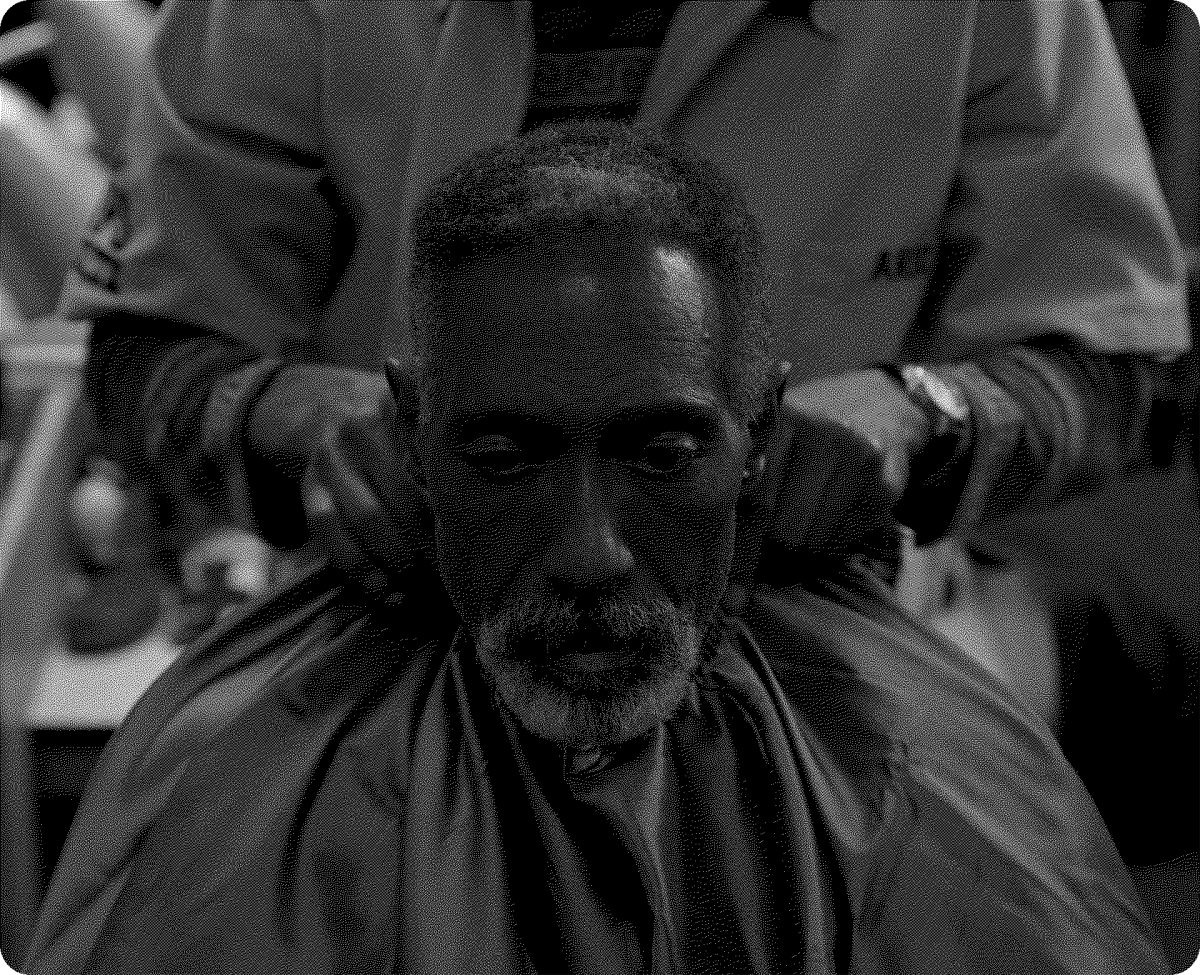
Clarence Moon had hands like banyan roots ⋯ thick and knotted, dark and steady. He’d been cutting hair since the summer of 1927, starting as a boy of fourteen in his uncle’s shop, sweeping the floor and lathering faces and learning the geometry of a fade by watching a man who understood his customers.
The shop that Moon opened on Wylie was twenty-four wide and forty deep, with three chairs and a shallow bench and a floor of black-and-white hexagonal tile that he mopped every evening after closing. The chairs were Koken, the good ones, with hydraulic lifts and a porcelain base. He’d bought them from a shop in East Liberty that was shutting down and he’d hauled them to Wylie himself, one-by-one, because a delivery hire would have cost too much. Once it was established for a while the place smelled of Barbicide and bay rum and the warm-metal tang of electric clippers. Beneath that was a trace of pipe tobacco from calabash breaks between customers. He quit the pipe in ’51 when his wife said his shirts smelled smoky. Alma was dead for four years, and Moon considered relighting the pipe on occasion. He didn’t. She had a point ⋯ the shirts and the shop were smelling better without it.
It was ten-fifteen on a Tuesday morning and Moon was giving a shave to Reverend Calvin Price of the Mount Ararat Baptist Church when the mail dropped through the slot. There was a soft clap of envelopes hitting the floor but didn’t look up from the Reverend’s jaw. He made three precise strokes on the left and wiped the blade on the cloth draping his forearm.
Hold still.
I am holding still.
The Reverend was not holding still. He never held still ⋯ parts of his body would attempt to rehearse the next sermon when the rest of him was trying to relax.
You’re twitching.
That’s the Holy Spirit.
You’ll be joining the Holy Spirit if you don’t sit quiet.
Moon completed the shave and applied a hot towel and walked to the door for the mail. Three envelopes. An electric bill; a circular from a supply company; a letter from the Pittsburgh Urban Redevelopment Authority, Office of Property Assessment.
He knew what it was before he opened it. He had known what it would be since the first surveyor arrived on Wylie fourteen months before. He had a clipboard and looked like he was measuring a grave. Moon sat in his preferred chair ⋯ the first one, nearest the window ⋯ and opened the envelope and unfolded the letter. He read it twice to be sure.
The assessed value of his property, for the purpose of eminent domain acquisition pursuant to the Lower Hill Redevelopment Plan, was $2,100.
Two thousand one hundred dollars.
He considered that number. Two thousand one hundred dollars for thirty-one years. For the chairs he had carried. For the tiles he had mopped. For the building he had maintained with his own hands and funds, replacing the roof in ’42 and the boiler in ’49 and the front window after that goddam Greenlee boy put a baseball through it in ’53. Two thousand one hundred dollars for a building that Mellon National Bank had appraised, just four months before, at nineteen thousand dollars ⋯ a figure that the bank called conservative.
Moon refolded the letter carefully and put it back in its envelope, then placed the envelope in the breast pocket of his barber’s coat.
Reverend Price, from under the towel, had registered the silence.
Everything all right there, Clarence?
Fine. Let me get that towel off your face before you suffocate.
The Lord calls us home by mysterious means.
Not in my shop He don’t.
Moon removed the towel, applied aftershave, and spun the chair toward the mirror. Reverend Price examined his jaw from both sides. He nodded. He appreciated competence in all forms, both sacred and secular. He paid his dollar fifty, blessed Clarence and left.
Standing at the window, looking out across the Avenue, Moon could see buildings across the street that were already empty. Two had boards over their windows and one had a broad red X on its door, painted by someone in overalls from the city.
He turned back and swept up and the next customer came in. The envelope stayed in his pocket through the day.
Interest ⋯
Desmond Moon was twenty-six and fond of billiards, hard bop, and mechanical puzzles. He started in the Army, then spent two years on the line at Westinghouse and hated it enough to quit. His uncle took him in for six month, at which point he landed a job at Federal Building Services. They cleaned offices after dark and paid one sixty-five an hour and didn’t ask much of their staff ⋯ show up sober and on time and don’t steal and you’re good.
He had the Title & Trust building on Fourth Avenue, floors three through six. Tuesday through Saturday from ten p.m. to six a.m. The work was nothing ⋯ vacuuming, mopping, clearing wastebaskets, wiping down desks with an ammonia-damp rag. Desmond could do all the tasks on autopilot and liked the quiet of the place and his freedom from harassment. He also found himself bored.
He became interested in a cabinet in Brockhurst’s office for the simple reason that it was the only one out four in a row always locked. It was a wafer lock, a cheap kind, and Desmond had learned to pick wafers from a fellow at the pool hall who’d learned the trick at Western Penitentiary. The man was a philosopher, of sorts ⋯ he explained to Desmond that the lock-making business was a confidence game to let white folk feel safer than they were.
The first time Desmond popped the cabinet he wasn’t looking for anything in particular. It was a Tuesday night in August and the building was empty except for him and the other cleaners on other floors and the single night security man. He was sixty-something and dozed in a chair by the elevator doors by the time it got to be past midnight.
The files were ordered alphabetically, which was helpful, with lettering that was tidy and clear. He found the first ledger in a fat folder labeled LOWER HILL ⋯ PARCELS A through F. He studied it standing in the office with a rag over his shoulder and the vacuum cleaner sitting upright in the doorway like a dog. There was also a PARCELS G through L and an M through R.
The numbers were laid out in orderly columns. The first column’s assessed values were absurdly low. The next column corresponded to the resale amount, the price at which Brockhurst’ intermediary ⋯ noted in parentheses beside each number ⋯ flipped each parcel up to the city. The second column’s amount was always triple or more the first column’s entry.
Then on to disbursements. Payments to someone named Pruitt. Payments to a numbered account. Specific items labeled simply JS ⋯ ADMIN.
He closed the cabinet and finished his shift. He returned to his Homewood apartment and sat on his bed and lit a cigarette and considered his options.
The camera was an Argus C3. The brick, the man at the pawn shop counter had called it, being nearly that size and shape with dials and knobs bumping out. Twelve dollars. He picked up six rolls of Tri-X, fast enough for low light without need of a flash, since random flashes firing off at two in the morning would be hard to explain if the security man stirred.
As the days went on he took shots of eighty-three documents. He was selective and careful and settled on a method. He would arrive for his shift, go about cleaning the offices and rest rooms in his usual manner, and take a fifteen minute break at one-thirty. During the break he would quickly pick the Brockhurst lock, remove a file, lay it open on the desk, then focus and frame, exhale softly, and trigger the Argus. This was not a precision instrument, so he was careful about alignment with the overhead light and stood on a chair to minimize skewing. Legibility would be crucial.
He developed the film himself. He learned how in the Army ⋯ two years at Fort Meade, where he learned nothing beyond the basics of photographic chemistry and how to disguise powdered eggs. His bathroom was barely big enough to serve a darkroom, with chemicals mixed in three coffee cans, and the prints were not quite as clear as he’d hoped ⋯ they were contrasty and slightly grainy and some ⋯ despite his efforts ⋯ were tilted a few degrees off level. But they were absolutely legible. Every number, every name, every line in the ledger showed where money came from and where it went and who helped it along its way.
He put the prints in an envelope and placed the envelope in a safe deposit box at the local branch of Dollar Savings. Being in Homewood made it a place that these men would not go. White folk had maps of the city that were detailed in some places and blank in others, the way old maps of the world had Europe in fine detail but sketched the rest as wavy mountains and monsters of the abyss. Homewood was where nothing but monsters lived.
The negatives went a darker place still.
He told his uncle about the photos on an early Sunday evening, with the shop’s door locked and the CLOSED sign up and low angled street light throwing patterns on the floor.
Clarence listened. He sat in the first chair perfectly still, without expression. When Desmond was finished he stayed mute, as if his nephew was still speaking.
He finally looked up and over.
How many sets?
Two. One in the box and the other out in Edgewood.
The negatives?
They’re safe. That’s a third spot and that’s real tight.
Clarence was looking somewhere over Desmond’s head.
Twenty-two thousand.
Sir?
Twenty-two thousand. That’s the correct number.
You know it’s worth a lot more than that.
Most everything’s worth more than you get for it. That’s just how it works.
Desmond gave a grunt. He waited for nearly a minute, but Clarence didn’t continue.
So when?
That brought him back, looking at Desmond directly.
Not yet. Leave it sit for bit. Patience ain’t much of a virtue, but timing sure is. We’ll let this ride for a while.
Balance ⋯
Spring came to Pittsburgh the same way as always ⋯ grudgingly, grumpily, like a season that was cheated the year before and expects to be cheated again. The snow turned to rain and then the rain turned to mud and then the mud ran out of better options. The mills burned day and night all through the year, but the quality of the fumes would move with the months. Spring brought a deeper, hotter orange to the clouds, so that the air over the South Side seemed about to catch fire.
Demolition was underway on Wylie. Not on Moon’s block yet, but close enough that he could hear it from the shop ⋯ the crack and low groan of old buildings coming down, the diesel rattle of pivoting bulldozers, the occasional crash of a wall taken by gravity. The sounds seeped through the window all day long ⋯ percussion from drunken, distant orchestra.
Customers talked about it in the way they would talk about weather. It was something that was happening that they could not stop and could only match with a sharp opinion.
Horace Gant drove a cab. He came in every third Thursday for a trim.
They’re building that arena right on top of us. Right on top of where we standing.
They’re not building it on top of us. They’re building it where we used to be. There’s a difference.
What’s the difference?
The difference is we won’t be here to feel it.
Gant considered the distinction.
Where you going, Clarence? When they come for this block?
Homewood. Got a cousin with a shop.
Homewood.
Gant pronounced it as if he were tasting the name.
Homewood’s all right.
Homewood’s Homewood.
Yeah, well ⋯ it’s all right.
Moon finished and reached for his badger-hair brush, the one best for removing loose hair from a collar because it was gentle against the neck. Gentleness at the end of anything was important. Even haircuts.
Gant paid and left. Moon swept below the chair up and checked the calendar on the wall behind the register. He had circled a date in pencil. That date was three days away.
Audit ⋯
Pruitt’s office was on the third floor. Moon walked past the lift for the start of the stairs. His knees weren’t what they’d been, but the stairs would give him extra time between the street and the office to be where nobody was watching or waiting. The only sound was his own breathing and the scuff of his shoes on the pale marble steps.
He was wearing his good suit, the gray one. Alma had picked out at Kaufmann’s, saying it made him look like a man who knew what he was about. He hadn’t worn it since her funeral. He was in it now because this was business, and business required a good suit the way surgery required scrubbed hands. Under his arm was a plain, unlabeled manila envelope.
The third floor receptionist was a freckled redhead with a worried expression, as though she’d been startled by something and hadn’t recovered.
I’m here to see Mr. Pruitt.
Do you have an appointment?
No.
Mr. Pruitt is very busy ⋯
I imagine he is. Please tell him that Clarence Moon is here about a Wylie Avenue assessment. I’ll wait.
The receptionist disappeared. Moon shifted the folder and removed his hat. The woman returned, still looking worried.
Mr. Pruitt can spare you a few minutes.
The office was roughly what Moon had expected ⋯ a desk too deep and a chair too short, a framed diploma on the wall and a drooping potted fern. Pruitt was standing behind his desk, which told Moon that he was back-footed, a little nervous. Which was good.
Mr. Moon? I don’t believe we’ve met.
We haven’t. But you introduced yourself by mail, telling me what you decided my property was worth. Thought I’d come by in person to discuss the value of your career. Sit down, Mr. Pruitt. This won’t take long.
Pruitt sat. It was involuntary and confusing, as he’d never take orders from others in his office, and certainly not from a walk-in civilian. Yet here he was, having sat.
Moon remained standing. He opened the envelope and began to remove the photographs, all eight-by-ten prints in plain black-and-white, slightly grainy but consistently legible. They were carefully positioned on Pruitt’s desk from left to right and top to bottom, paving over his papers and pens and cigarette pack.
The first shot, top-left, was a disbursement ledger. The second was a counter-appraisal showing the true market value of a parcel that Pruitt had assessed at eleven hundred dollars. The third was a letter from Brockhurst to an intermediary detailing the commission structure. The fourth, top-right, was a canceled check. On the next row the first shot was another canceled check. Then shots of pages from another ledger that showed the flow of funds from the intermediary back to Pruitt’s personal account at Pittsburgh National Bank. The last row included memos ⋯ handwritten and initialed ⋯ that described the timing of payments relative to assessment filings. Also a note that referenced, in what appeared to be Brockhurst’s hand, the alderman’s administrative fee. The twelfth and last photo was of a safe deposit receipt with the bank name masked from view. It served as proof that the evidence was secure but accessible.
Pruitt looked at the photographs. He stared at each of them, in turn, the way a man looks at an X-ray with suspicious dark spots.
Where did you get these?
That’s not the question to be asking. The question you should be asking is what I want.
He looked up from the desk.
What do you want?
I want twenty-two thousand dollars for my building on Wylie Avenue. Certified check. Fourteen days.
Twenty-two thousand? That’s ⋯
That’s three thousand more than the bank says it’s worth and twenty thousand more than you say it’s worth. I’d say that’s reasonable, considering the circumstances.
Pruitt opened his mouth. Closed it. Opened it again. He looked like a fish on the plank of a dock.
And if I can’t ⋯ if the Authority won’t approve ⋯
The Authority won’t need to approve anything. You’ll find the money. You can make the numbers work.
Moon paused and allowed it to linger. A pause, in his experience, was the most persuasive form of speech. It said: I have more to say, but I don’t need to. It said: You know what happens next.
A pause was the sound of a door swinging shut.
If I don’t have a certified check in fourteen days these photographs, along with others, get sent to two places. The first is the Pittsburgh Courier. They’ve already got a man asking questions about the Hill. His name is Frank Bolden and he’s good at his job and he would find these mighty interesting. The second is a federal housing inspector in Washington, D.C., a man named Charles Whitney, with whom I have been corresponding. Mr. Whitney is also good at his job. He would also take an interest.
Moon replaced his hat and adjusted its brim.
Fourteen days, Mr. Pruitt.
He walked out. He took the stairs down and his knees hurt but that didn’t bother him much because something else held his attention. It didn’t register as joy or triumph or relief. It was more the feeling of having done a necessary thing, and doing it cleanly and precisely, the way you finish one side of a shave ⋯ three strokes and a wipe and not a nick on the neck.
Liability ⋯
Pruitt called Steffka at four-seventeen. He’d been glancing at his watch while progressing through stages of panic ⋯ denial and evasion, then damage control, then bargains with devils and visions of violence. He finally arrived at the only viable option, which was to call the only man he knew with the means to deal with this.
The phone rang once. Twice.
Who is it?
Walter Pruitt. Ah, sir, I’m afraid we’ve got a problem.
Dear air on the line. Pruit was ready to repeat himself.
We. What is this we?
The visit was related in detail ⋯ the photographs and their content and the citizen who delivered them and the demand that this citizen made.
Steffka listened quietly. When Pruitt finished he had a question.
The photographs. Do they show payments to me by name?
There’s a notation. JS ⋯ ADMIN. And one of the memos references your office.
References. A notation. Not a fully spelled-out name?
It says ’alderman’s administrative fee.’
The threat was manageable. JS ⋯ ADMIN was not the same as Joseph Steffka and an alderman’s office fee was in no way a bribe. Such things could be briskly dismissed. The threat to Pruitt himself, however, was serious. The photographs showed his name, his account number, his depressed assessments, and the amounts flowing from the intermediary into Pruitt’s own pocket. If those photographs reached the Courier, Pruitt was finished. If they made it to Washington, Pruitt was in prison.
Worse for Pruitt, for six months before citizen Moon stepped in the man was already a problem. It was clear that he was skimming. Not the agreed-upon skim that they shared, but a second take, a private one, a chronic diversion from the intermediary entity’s flow. It was an impertinence. Worse, it was a liability.
How much does he want?
Twenty-two thousand.
For a barbershop?
Yes, for his barbershop.
Cut a check.
Sir, if we pay it, the others ⋯ if word gets out ⋯
Word won’t get out. Your barber won’t talk. A man like that does not talk, he acts and then he’s done. Pay him and he’ll go away.
Walter ⋯
Steffka’s voice switched its tone now, went warmer, almost solicitous, which would have terrified Pruitt were he a smarter man.
⋯ Walter, I’m going to handle this. Don’t worry about the barber. Don’t worry about his pictures. I can care of this thing.
What are you going to do?
I’m going to make it go away. That’s what I do on this side of town. Just cut his check and send it to my office. Don’t include a note. I’ll know by the name.
He hung up. He did not say goodbye.
He sat in his office above the hardware store and relit his cigar and stared at the frame on the facing wall. His father and grandfather were standing outside the Jones & Laughlin gate, both in their work clothes and squinting, both looking like they’d been carved from igneous stone.
He picked up the phone.
Eddie? Swing by after your shift. I’ve got a job for you.
Liquidity ⋯
Detective Edward Banasz, at age forty-nine, had been serving on the force for twenty-three years. The last fourteen had been spent in a state of compromise so deep and complete that corruption simply felt like the nature of things. He was not a brutally bad man ⋯ not one to enjoy back alley shakedowns or the breaking of legs. He was just a man who had arrived at an obvious conclusion ⋯ the same conclusion that thousands of men in other cities had made ⋯ which was that the salary of a police officer was not sufficient to support a family in the manner that his family deserved. The supplemental income offered by someone like Steffka was, viewed correctly, no different than conventional overtime.
The call came on Thursday afternoon. After they met and Banasz had time to think and sleep and think some more, he’d arrived at a workable plan.
The poison of choice for people like the Pruitts was inhaled carbon monoxide. It was colorless, odorless, brought a death that looked like sleep, and if circumstances were arranged correctly ⋯ a car running in a closed garage, with a known-to-be-despondent man slumped behind the wheel ⋯ then death looked natural. Unfortunate, sure, but hardly suspicious. It was something that someone does when the world becomes too much, which was a story readily accepted because the world was, in fact, too much for many people much of the time.
Detective Banasz spends two-and-half weeks circling and observing the Pruitts. He learns their schedule. He notes that Pruitt’s wife, Eleanor, attends a garden club meeting at the Mount Lebanon Women’s Club on alternate Wednesdays from six until nine. He discovers that the garage at the Pruitt residence is attached to the house by a breezeway with a door that doesn’t properly lock.
On Wednesday evening, three weeks after Steffka’s call, Eleanor Pruitt drives to her garden club meeting in the household’s second car, a green Bel Air. Walter Pruitt is in the house, per usual for that weeknight and time.
Banasz parks two corners down at seven-fifteen and walks to the Pruitt house in fading light. Dim enough to suffice. The neighborhood is quiet and the houses are back from the sidewalk behind immaculate Mount Lebanon hedges and lawns.
The breezeway door is unlocked. The garage is dark and the Ninety-Eight, cream and tan, is parked. He opens the garage door partway to let himself in, then closes it behind and closes the side door to the breezeway. He checks the door seals. Tight as the seams of a box.
The next part takes four minutes. Then he moves Mr. Pruitt, finds his keys and starts the Olds, and wipes surfaces with a borrowed kitchen towel while the engine settles to idle. He exits through the breezeway, pulling the door firmly shut, and walks back to his car in full darkness to drive directly home.
Pruitt had been stealing. He told himself that Pruitt had been stealing from Steffka and the city and plenty of people on the Hill, and that a man who steals that much eventually has to pay for it. This was the payment.
Back home, he poured a drink. After downing it he poured another and drank that too. But he did not pour a third because a third would be losing control, and control was the one thing he had left.
Assessment ⋯
Eleanor Pruitt returned at nine-twenty to find her husband in the Ninety-Eight, engine running and the garage full of fumes that burned her throat and eyes. She screamed once, loud and sharp, with a sound that the nearest neighbor would describe as like a bird hitting a window.
The police arrived. Then the fire department and then eventually the coroner. They did all the things they were paid to do when a citizen is found dead in a running car in a closed garage ⋯ they took photographs and measurements and statements that they compiled in notebooks, and the notes told the story that Walter Pruitt, overcome by pressures profound and imponderable, was found in circumstances consistent with self-administered monoxide poisoning.
Nonetheless, it was deemed an accidental death. This mattered to Eleanor, being both Catholic and the sole beneficiary of a policy wouldn’t pay on a suicide. A man could neglect to open his garage door and fall asleep at the wheel and die with his hands safely draped at ten and two. This was sad but not suggestive. Not suspicious.
Steffka did not attend the funeral but sent a fine bunch of flowers. He always sent a nice arrangement. He had an account with an outfit on Carson Street, where they always knew what was needed and the delivery address because Steffka’s flowers were a regular feature of the Allegheny funerary landscape.
Transaction ⋯
On the Tuesday following the funeral a white man, alone, stepped into Clarence Moon’s barbershop. It was two-fifteen and the shop was in a lull between customers, the light through the window coming low and long and golden, falling across the chairs and the tile and the tonics on the shelf in front of the mirror. A lull at that hour was unusual, so the timing was peculiar.
The man was not tall but was wide, which conveyed some presence. He wore a dark coat and a dark hat and his face ⋯ creased but expressionless ⋯ was that of a man who’d composed his own features.
Mr. Moon?
That’s right.
Joseph Steffka. I hope I’m not interrupting.
You are not. Have a seat wherever you like.
Steffka considered and then selected the middle of the three Kokens. He turned himself around and stepped back, taking the seat carefully, as though testing a new hypothesis. Then a nod when he settled in, secure.
I won’t waste your time. I’ve become aware of irregularities in some of the appraisals conducted by my late colleague, a Mr. Pruitt. Specifically, certain properties in the Hill District appear to have been undervalued.
Moon waited.
Substantially so. This property among them.
Moon shifted to the first chair, his favorite, and angled it slightly toward Steffka. He sat and folded his hands on his apron.
I’ve had your property reappraised by an independent assessor. The revised figure is twenty-two thousand dollars. I have a certified check here for that amount, drawn from a municipal account.
Steffka reached into his coat and produced a plain white envelope. He balanced it upright on his armrest, pinched between his thumb and two fingers. Moon looked at it, surprised to find the bulk of his worth looking small and so thin and so casually handled. He let it perch there for a moment.
I trust you’ll find this more appropriate.
He finally leaned forward and reached over. Steffka mirrored his movement to hand it across. Moon lifted the flap, glanced in, then placed it in the breast pocket of his barber’s coat ⋯ the same starched pocket where he’d placed the letter from the Redevelopment Authority, the one that stated his building was worth $2,100.
It will do.
"Glad to hear that. And the materials you discussed with Mr. Pruitt?
Moon didn’t blink.
Materials were never discussed. Your man Pruitt and I never met. I don’t know any Mr. Pruitt.
Steffka studied Moon. The response didn’t surprise and his options remained open. Working his way through them, he noticed that the place smelled a bit like Barbicide. Then he spotted, over Moon’s shoulder, two aqua-blue cylinders on the counter, one with several combs and the other with shears. Such a cheerful, pretty shade of light blue.
He decided he knew his man. They were done.
Thank you for your time, Mr. Moon.
Thank you for the adjustment, Mr. Steffka.
Steffka stood and adjusted his coat and his hat. He walked to the door and as he opened it the top bell made its jingle and Moon caught a glimpse of another man outside. The door swung and the bell rang again as they moved past the window together. The bell’s brassy ring was the same either way the door went.
Depreciation ⋯
Clarence Moon closed his shop on a Saturday in May. It was closed the way it was opened, quietly and carefully, because Clarence shunned drama and shortcuts. There was only the work to attend to when the work was before you ⋯ and wasn’t there always some work to be done?
He packed his tools into two leather cases that he owned from the start ⋯ clippers and shears, razors and strops, combs and brushes. He packed them the way a doctor might pack his medical bag, each instrument in its place in a wrapper of cotton, because these item provided his living.
He mopped the floor a last time, starting at the back and working forward, the mop moving in long arcs across the tile. The tile would be reduced to rubble and then the rubble, soon enough, would join the gravel beneath the asphalt of the new Civic Auditorium parking lot.
After Moon finished mopping he emptied the bucket in the utility sink in the back. Then he hung his apron on the hook behind the door. He stood in the center of the shop and checked the chairs, the mirror, the shelf, the window, the light. He thought of Alma. He missed her but was glad she was gone on this day.
Trade ⋯
Homewood was not the Hill. Homewood was its own thing ⋯ a neighborhood of frame houses and brick storefronts and elm trees like fat drunken sentries.
Moon bought a chair in his cousin Teddy’s shop on Frankstown, a joint called Teddy’s Cuts that was smaller and noisier than Moon’s old shop because Teddy kept the radio tuned to WAMO and his customers were a younger crew.
Moon settled in without complaint, coping with the environment. Some of his customers followed him ⋯ the ones who lived close enough or cared enough to take the bus to Homewood to be groomed by a trusted pair of hands. Reverend Price came. Horace Gant came. Not everyone came.
He did not like to talk about the Wylie shop. He cut hair and gave shaves and continued to mop the floor, which was no longer hexagonal tile but a light gray linoleum that was easier to clean but not nearly as nice.
Appraisal ⋯
The Civic Auditorium opened on September 17, 1961, a Sunday, which God had earmarked for rest but which the city of Pittsburgh had set aside for ribbon-cutting and self-congratulation.
The building was enormous. It rose from the cleared expanse of the Lower Hill like a flying saucer erupting from a graveyard ⋯ all steel and concrete and unbridled ambition. The stainless dome caught the light and threw it back at the sky as if to say: Look what we can do. Look what we can make when we take what we need.
The gala opening was a formal affair, with men in tuxedos and women in waterfall gowns. The mayor presided, the governor sent a deputy, and every member of the city council was in a banquet row for a raised-glass series of photographs.
Alderman Joseph Steffka was there, standing in the lobby and shaking hands and smiling as he kept repeating ⋯ wonderful, tremendous, a great day for Pittsburgh. It came off as effortless, the way a tightly-tooled press stamps out parts.
The mayor approached.
Joe. Hell of a thing, isn’t it?
It is, Your Honor. One hell of a thing.
You’ve been a key part of this
I’ve done what I can.
They shook hands and turned together and a burst of flashbulbs went off.
Moon was not at the opening. He was not invited and would not have gone anyway, as Clarence Moon had no interest in buildings shaped like alien spacecraft.
He was in Teddy’s shop earlier in the day. It was normally closed on Sunday but Moon had a customer, a regular named Willis who needed a trim before the funeral for his brother.
Willis sat in the chair and Moon draped the cloth and attached the silver fastening clip.
Big to-do today, Clarence. Mayor and everybody.
Sounds like.
Twelve thousand seats in one space. Can you imagine?
Two regiments, at least.
And right where your shop was.
No, no, not right on the shop. Pretty close, though.
Close enough.
Moon ran the clippers in smooth upward strokes, working his way steadily around.
You think much about it?
About what?
You know ⋯ the place gone, the folks gone with it.
Moon put down the clippers and picked up his shears.
There’s a man I think about once in while.
The shears began their rhythm, which started as a flex in Moon’s forearm, ran down through his wrist, then expanded across his thumb and three fingers.
He worked a while to get that thing going. Never got to see it go up.
He pass?
Indeed he did. Not sure where exactly to.
I’ve got a good guess where my brother might be.
That’s a comfort, ain’t it?
Surely is to his wife.
At which point Willis laughed and Moon laughed and had to pause for a second to steady the blades in his hand.
He brushed away the clippings with the badger-haired, gentled-ended brush. Willis paid and left and Moon swept up, moving the bits into a pile and the pile into a dustpan and the dustpan into the trash. Then he hung up the broom and locked the door going out.
The dome curved in the distance past Frankstown Avenue, flashing like a scythe in the glare of the sun.